Maruti Suzuki S-Presso Becomes India’s Cheapest Vehicle After GST Rate Cut
India’s car market has shifted to a new level of affordability and competitiveness after the latest Goods and Services Tax (GST) rationalization. As GST rates were lowered and further price cuts made by carmakers, the pecking order of India’s cheapest cars has been reordered. At the forefront of the change is Maruti Suzuki, whose product strategy has deliberately repositioned its range to appeal to price-sensitive buyers.
For the very first time in eleven years, the Maruti Suzuki Alto has lost its position as India’s cheapest car. The title now belongs to its cousin, the S-Presso mini SUV, which has been aggressively repriced to become India’s most affordable four-wheeler.
GST rationalisation: The trigger for change
The government of India on September 4, 2025, made one of the largest GST reforms since its launch in 2017. The slabs were cut down from four (5%, 12%, 18% and 28%) to two main slabs of 5% and 18%. For automobiles, the GST Council also created a 40% slab for big luxury and performance cars and rationalised small cars under the 18% slab.
This rationalization came directly to the aid of small cars such as Alto, S-Presso, Wagon R, and Celerio, which fall in the government’s “small car” category — less than 4 meters in length with petrol engines less than 1,200 cc or diesel engines less than 1,500 cc.
With this initiative, companies like Maruti Suzuki have been able to cut ex-showroom prices sharply, transferring the advantage directly to customers.
S-Presso: The new entry-level champion
From September 22, the entry-level version of Maruti Suzuki S-Presso will begin at ₹3.49 lakh. This is an 18% decrease over its previous price of ₹4.26 lakh. In absolute terms, customers can save up to about ₹76,600 on the base model, and the highest benefit can increase to almost ₹1.3 lakh on top trims.
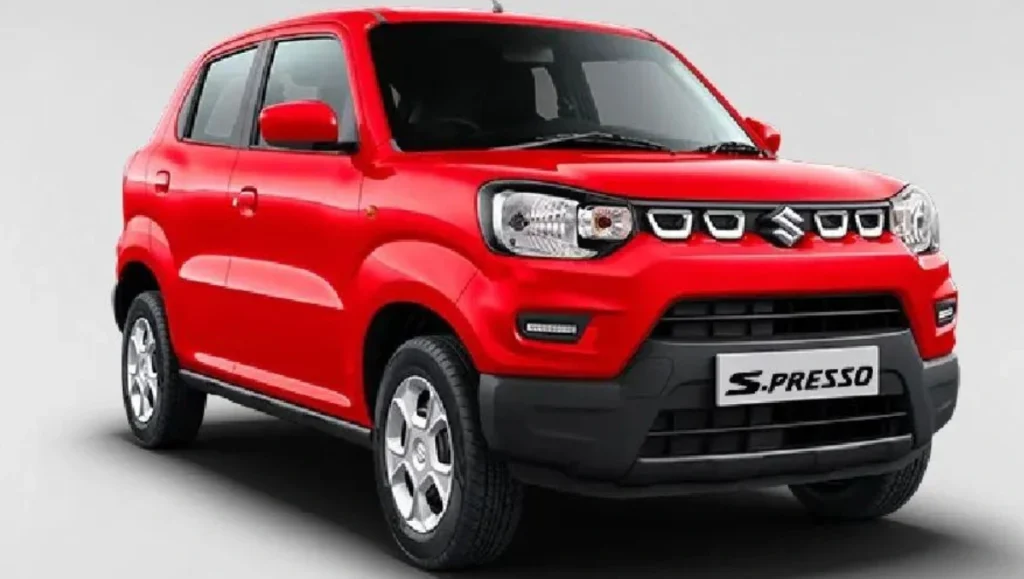
The Alto, which used to be the benchmark for price, now begins at ₹3.69 lakh following a cut of nearly 12.5% or ₹53,100. Before these reductions, the Alto cost ₹4.23 lakh, being slightly less than the S-Presso’s ₹4.26 lakh. The change in pricing order now positions the S-Presso as India’s most affordable car.
Maruti Suzuki’s marketing and sales senior executive officer, Partho Banerjee, said that the company is exceeding GST-related price cuts. “The net impact of the GST cut from 29% to 18% is 8.5%. We have exceeded that for our two-wheeler customers with a special offer,” he said.
Why Maruti Suzuki is placing its bets on price cuts
The car segment at the entry level has been under a lot of pressure over the past few years. Higher vehicle prices, increased down payments, and mounting EMI loads have deterred first-time customers — particularly two-wheeler owners — from buying cars.
Between April and August 2025, Maruti Suzuki’s mini segment, comprising the Alto and S-Presso, reported a 35% year-on-year decline in sales. To counter this, the company has introduced additional cuts on top of the GST benefits to revive consumer interest.
For Banerjee, the move is to stimulate demand among first-time buyers of four-wheelers who are weighing their first car purchase. By opening up cars for wider consumption, Maruti Suzuki believes it can narrow the pricing gap and trigger volumes in the languid entry-level segment.
Other small cars also receive price cuts
The advantages of the move are not limited to the Alto and S-Presso alone. Maruti Suzuki has applied similar cuts to other small cars in its portfolio.
- Celerio: Now ₹4.69 lakh, down from ₹94,100 (about 17%).
- Wagon R: New price is ₹4.98 lakh, lower by ₹79,600 (about 13%).
These cuts form a special limited-period offer, Maruti Suzuki has stated, which will be under review by December 2025.
Strategic implications for the car market
This bold pricing move is expected to have far-reaching implications. With the S-Presso now the cheapest car in India, Maruti Suzuki has strengthened its dominance in the entry-level segment. The new positioning not only challenges rival carmakers but also broadens the appeal of Maruti’s compact models to budget-focused buyers.
Industry analysts think the aggressive pricing plan will set off competition among carmakers to reposition their products, specifically in the low-end car segment. But not all makers have the scale and cost advantage of Maruti Suzuki, and that could prove to be a major competitive advantage for India’s largest automobile manufacturer.
Compensation and dealer issues
While the GST reductions find universal acclaim, dealers have expressed concern over compensation cess and its effects. Banerjee clarified that Maruti Suzuki will compensate its channel partners directly for the price cuts. In the meantime, industry associations are holding discussions with the government to address concerns regarding cess and facilitate smooth implementation.
Conclusion: Affordable cars regain spotlight
With the GST rationalisation and Maruti Suzuki’s strategic pricing, India’s entry-level car market is poised for a revival. The S-Presso, now positioned as the most affordable car in the country, marks a return to focus on affordability, a segment that had been fading in recent years due to rising costs.
By offering two-wheeler owners and first-time buyers big discounts, Maruti Suzuki is trying to rekindle demand in an important segment. Whether these discounts will bring sustained growth is yet to be seen, but for the moment at least, India’s price-conscious car buyers have lots to smile about.
—