Renault kwid EV as kwid E-Tech Unveiled in Brazil – Price, Features, Range, and Anticipated Specifications
The Renault Kwid EV Unveiled in Brazil and set to make its entry into the Indian electric vehicle market as one of the most cost-effective and efficient urban EVs. Commonly referred to as the Renault Kwid E-Tech outside of Brazil or Dacia Spring EV in Europe, this subcompact hatchback blends contemporary looks, economical performance, and cost-conscious pricing. As the Indian EV market is expanding strongly, the Renault Kwid EV is set to compete head-on with the Tata Tiago EV, MG Comet EV, and Citroen eC3.
Renault Kwid EV – Global Overview
The global EV lineup of Renault has been expanding with the Kwid E-Tech already in production in Brazil and the Dacia Spring EV being a hit across Europe. The Brazilian variant, which costs about BRL 99,990 (about Rs 16 lakh), will be the basis for the coming Indian model. Sharing the same platform as the petrol Kwid, this electric variant has been engineered to provide an economical way of entry into electric mobility without sacrificing comfort or usability.
The Renault Kwid EV will be locally manufactured in the Renault-Nissan Alliance factory in Chennai, which will enable the company to maintain costs at competitive levels. Rumor has it that the launch could happen between January and March 2026 and that the price could range between Rs 9 lakh and Rs 12 lakh (ex-showroom).
Bold and Urban Design
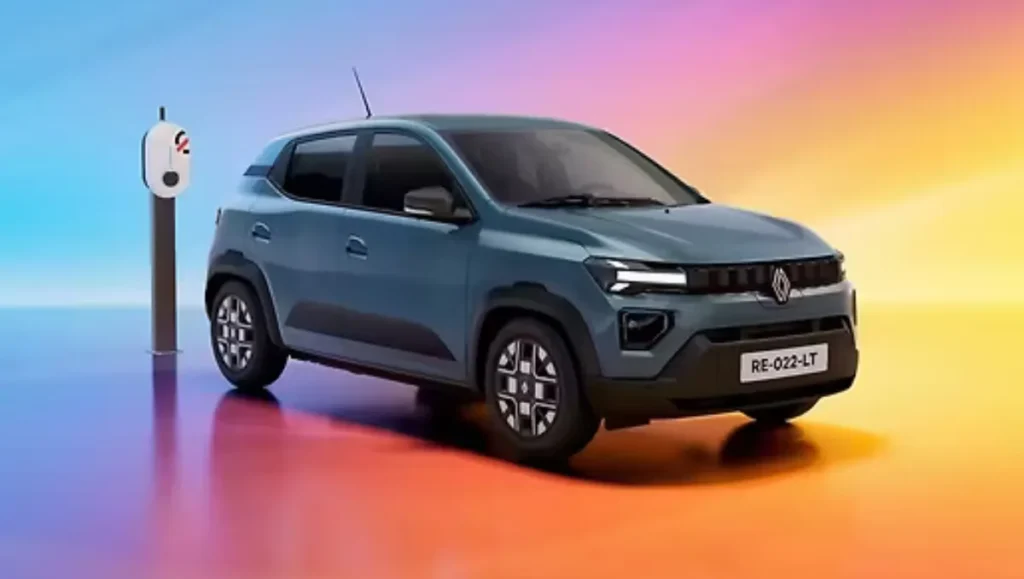
The Renault Kwid EV carries forward the same compactness of the regular Kwid but presents a more futuristic and EV-centric design. The face has a closed-off grille with vertical slats and the new Renault badging, surrounded by Y-shaped LED DRLs and projector headlamps. The charging socket is well incorporated in the front bumper for a clean and symmetrical appearance.
At the side, the hatchback receives twin-tone 14-inch alloy wheels, chiseled wheel arch cladding, and black door protectors on the side that add to its city charm. Turn signals are built into the ORVMs, and Renault proceeds with flap-type door handles, retaining a familiar feel for existing buyers.
Towards the back, the Kwid EV features Y-shaped LED taillamps bonded by a sophisticated black plaque, a new bumper, and E-Tech badging that celebrates its electric stature. Overall, the design appears chic, compact, and aerodynamic – ideal for urban drives.
Interior and Features
Within the Renault Kwid EV, the interior embodies a contemporary, technologically savvy design. The dashboard design is minimalist and tiered, with a 10.1-inch touchscreen infotainment system taking center stage that is compatible with wireless Android Auto and Apple CarPlay. Adding to this configuration is a 7-inch digital instrument display that shows vital EV data like battery level, range, and energy use.
The centre console features an e-shifter in place of a traditional gear lever. The convenience features are automatic climate control, a height-adjusting steering wheel, a number of USB Type-C charging points, and a 290-litre boot capacity. Renault has employed contrasting textures and Y-shaped trims on AC vents in order to provide the interior a premium feel.
For convenience and safety, the Kwid EV will have six airbags, ABS with EBD, electronic stability control, hill-start assist, a tyre pressure monitoring system, and a rear parking camera. Importantly, the hatchback will also receive Level 1 ADAS with the features of forward collision warning, lane departure alert, and automatic emergency braking – a segment-first feature at this price level.
Powertrain and Performance
Unasonically, the Renault Kwid EV is driven by a 26.8 kWh lithium-ion battery set alongside an electric motor that produces 65 bhp and 113 Nm of torque. This configuration makes the car go from 0–100 kmph in about 14.6 seconds, which is quick enough for city drives.
Renault estimates that the battery has a 230–250 km real-world driving range on a single charge. The vehicle is capable of 30 kW DC fast charging, which takes around 40 minutes to fill 15 to 80 percent. With a 7.4 kW AC wallbox, the same amount of charge will take around 2 hours and 54 minutes, while a normal 2.3 kW charger will take approximately 9 hours to fully charge.
Across the globe, the Dacia Spring EV – the base vehicle on which the Kwid EV is developed – has launched a new lithium iron phosphate (LFP) battery and more powerful motors of up to 70 hp and 100 hp. If Renault transits these developments to India, the Kwid EV may have even greater performance, faster charging, and improved battery safety.
Safety and ADAS Features
The Renault Kwid EV is likely to introduce new safety benchmarks for compact electric hatches. Apart from six airbags and a body with robust strength, Renault will probably offer Level 1 ADAS features like:
- Forward collision alert
- Lane departure alert
- Traffic sign recognition
- Automatic emergency braking
- Driver focus alert
Other important safety features will be ISOFIX mounts for child seats, rear parking sensors, and electronic stability control.
Expected Price and Competitors
The Renault Kwid EV is expected to be one of the cheapest electric vehicles on sale in India. Priced between Rs 9 lakh and Rs 12 lakh (ex-showroom), it will challenge the Tata Tiago EV, MG Comet EV, and Citroen eC3. Renault’s pricing strategy and localization may provide the Kwid EV with the lowest priced long-range EV in India.
It is already the most economical electric car in Brazil, and Renault is hoping to achieve similar success in India by providing value for money, efficient performance, and low maintenance costs.
Renault Kwid EV – India Launch Timeline
Though Renault has not officially announced, reports indicate that the Renault Kwid EV India launch may happen early in 2026. The vehicle will be produced at Renault-Nissan’s Chennai plant, with local component sourcing to ensure affordability.
Renault also intends to enhance its EV portfolio in India, with upcoming products potentially featuring the next-gen Duster and potential hybrid SUV.
Final Thoughts
The Renault Kwid EV, which is coming next, guarantees to deliver low-cost electric mobility to Indian consumers who want a stylish, compact, and functional urban car. With contemporary features, Level 1 ADAS, a spacious cabin, and an efficient electric powertrain, the Kwid EV is likely to become one of India’s most sought-after electric hatchbacks.
If Renault is able to offer a competitive price point combined with strong after-sales services, the Kwid EV has the potential to lead the country’s mass adoption of EVs — positioning it as a real game changer in India’s electric vehicle market.
Frequently Asked Questions – Renault Kwid EV (Kwid E-Tech)
1. When will Renault Kwid EV be launched in India?
The Renault Kwid EV will be launched in January-March 2026.
2. What will be the price of Renault Kwid EV in India?
It is expected to be priced between Rs 9 lakh and Rs 12 lakh (ex-showroom).
3. What is the Renault Kwid EV’s driving range?
The Kwid EV has an actual range of around 230–250 km on a full charge.
4. What battery pack does the Renault Kwid EV have?
It is equipped with a 26.8 kWh lithium-ion battery pack.
5. How long is the Renault Kwid EV charging time?
With a 30 kW DC fast charger, it takes around 40 minutes to charge from 15 to 80 percent.
6. What are the most prominent features of the Renault Kwid EV?
It features a 10.1-inch touchscreen, 7-inch digital display, automatic climate control, and Level 1 ADAS.
7. Is the Renault Kwid EV equipped with ADAS?
Yes, it comes equipped with Level 1 ADAS with safety features such as forward collision alert and lane departure warning.
8. Who are the primary competitors of the Renault Kwid EV in India?
Its major competitors include Tata Tiago EV, MG Comet EV, and Citroen eC3.
9. In which factory will the Renault Kwid EV be built?
It will be produced locally at Renault-Nissan’s Chennai facility.
10. Why is the Renault Kwid EV unique?
It merges low price, stylish looks, and hi-tech safety features, and is perfect for city customers.
—