Government proposes stricter Bharat NCAP 2.0 bringing major changes to car safety rules
The phrase Government proposes stricter Bharat NCAP 2.0 appears right away because this shift matters now for every driver, manufacturer and everyday vehicle. In simple, conversational terms: India is about to tighten how safe our cars really are. The revised safety regime being developed under the scrap of this new version of the Bharat NCAP means car makers will face tougher crash tests, wider protection, and more clarity for consumers.
Below I walk you through: what this new draft covers, what’s changed, how it affects you as a buyer or driver, and some caveats to watch.
What is Bharat NCAP and why 2.0?
Bharat NCAP is an Indian safety program designed to test more than just road fitness, examining how effectively a car keeps its passengers safe during actual accidents. It is voluntary but influential.
Now, in the draft version named Bharat NCAP 2.0, the government proposes to raise the bar. The earlier system largely covered adult occupant protection, child occupant protection, and some safety assist technologies. Under 2.0 the scope broadens considerably. The kicker: car safety won’t just be about you inside the vehicle, but also about those outside it.
Key Changes in Bharat NCAP 2.0
Here are the major features of the updated scheme, in everyday speak:
Five assessment areas
Under the new draft, the star rating is based on five verticals:
- Safe Driving technologies (~10 % of total)
- Accident Avoidance (~10 %)
- Crash Protection (~55 %)
- Vulnerable Road User Protection (~20 %)
- Post-Crash Safety (~5 %)
These weightings mean crash protection remains the largest slice, but protection of people outside the car (pedestrians, two-wheelers) gets real attention.
More crash tests
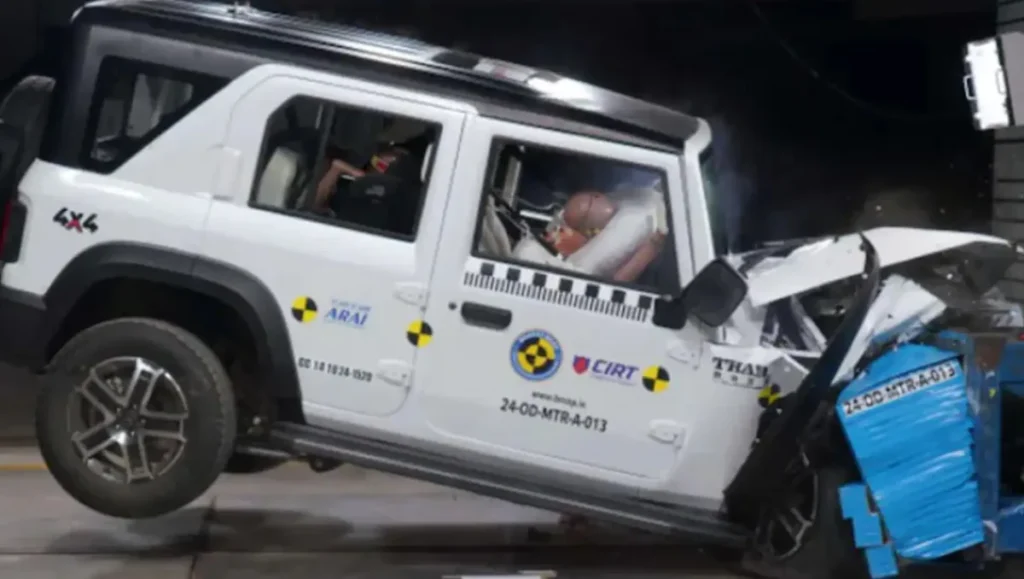
The draft expands the number of mandatory crash tests from three to five. These now include:
- 64 km/h offset frontal impact against a deformable barrier
- 50 km/h full-width frontal impact (new)
- 50 km/h lateral impact against a mobile deformable barrier
- 32 km/h oblique side-impact (pole test)
- 50 km/h rear impact against a mobile rigid barrier
This means vehicles will be judged in more varied crash scenarios — front, side, rear, full width.
Vulnerable road user (VRU) protection
One of the biggest shifts: a 20 % chunk of the rating now goes to how well a vehicle protects people outside the car. That includes pedestrians and motorcyclists. Tests for this vertical cover leg-form impacts on the bumper, adult and child head-form hits on the bonnet and windscreen area, and optional checks of autonomous braking systems for pedestrian/motorcycle scenarios.
Tighter star-rating criteria
The draft lays down stricter thresholds. For instance a five-star rating (in its rollout phase) will need about 70 points out of 100 (rising later to 80). Also, a vehicle cannot score zero in any one vertical and still get five stars. Minimal performance in each pillar will matter.
Mandatory features and timing
The proposal makes ESC and curtain airbags essential for any rating. AEB remains optional but continues to offer bonus points. Stakeholders can comment on the proposal now, and the government plans to bring it into force around October 2027 after the current norms end.
Implications for buyers, manufacturers and roads
For car buyers
If you are shopping for a new car, the “Government proposes stricter Bharat NCAP 2.0” update means you need to watch:
- Will the model you buy have the new safety technologies?
- What rating did it get under the new regime (when available)?
- How the manufacturer has prepared for more realistic and demanding tests?
In short: five-star ratings may become harder to get, so you cannot assume that a five-star from the old scheme means the same under the new one.
For manufacturers
Automakers will need to engineer cars with stronger structures, safer pedestrian impact zones and additional active safety tools. Naturally, prices will rise. And since the rules kick in by 2027, cars being designed now must be built to meet them. Plus, vehicles offering side-facing seats might not be eligible for a rating.
For road safety in India
This shift has a broader social angle. A large proportion of road fatalities in India are pedestrians and two-wheeler users. By giving VRUs a dedicated weightage and realistic tests, the safety net extends beyond just car occupants. If implemented well, this could reduce crash severity and maybe even lower deaths and injuries at scale.
Things to keep in mind / caveats
- The draft stage: Since these are proposed rules, some details may change. Car makers and industry bodies have the chance to comment.
- Timing: Implementation is set for around October 2027. Until then, the current Bharat NCAP stays in force.
- Cost implications: With tougher tests and new tech, car prices may increase marginally.
- Voluntary nature: Even with stricter rules, unless and until the ratings become mandatory or heavily marketed, buyer awareness will matter a lot.
- Interpretation of ratings: A five-star under the old vs new regime will not be exactly equivalent. Buyers must compare with context.
- Real-world conditions: Tests replicate scenarios but cannot cover every edge case on India’s diverse roads. Safety depends also on driver behavior, maintenance and infrastructure.
Why this matters right now
We’re at a point where Indian vehicle safety is catching up with global norms. The fact that Government proposes stricter Bharat NCAP 2.0 shows a clear push to lift safety standards, follow better practices, and enhance protection across the industry. For ordinary drivers and the broader community, stronger safety means fewer lost lives, fewer major injuries, and reduced financial burden caused by accidents.
In a market where the line between base and premium models often rests on safety equipment, such revisions add clarity. If a manufacturer promotes a strong safety rating, buyers will now have more reliable data to test whether that promise holds up under tougher evaluation.
Put simply, this isn’t only about ratings, it’s about real-world impact.
Takeaways
In conclusion, the idea that Government proposes stricter Bharat NCAP 2.0 is far more meaningful than it first appears. It points to a new structure in how safety will be developed, tested and shared with the public. For buyers, it suggests sturdier vehicles with improved protection, both inside and out. For the industry, it means raising standards. And for the road ecosystem, it offers hope for fewer tragedies. If you are monitoring safety norms or considering a car, this deserves focus.
Faqs – Government proposes stricter Bharat NCAP 2.0 bringing major changes to car safety rules
FAQ 1: What is this Government proposes stricter Bharat NCAP 2.0 thing, in simple words?
It’s basically the government tightening the way car safety is tested. So instead of easy ratings, cars now have to work harder to prove they’re safe. For normal people like us, that just means the stars will mean something more real.
FAQ 2: Is Bharat NCAP 2.0 already running?
No, not yet. Right now it’s just a draft. The real changes are expected around 2027, so we still have time.
FAQ 3: Are car prices going to shoot up because of this?
Not shoot up, but yeah, prices may creep up. Stronger body, more airbags, more sensors all cost money. Companies usually pass at least some of that to buyers.
FAQ 4: Should I feel unsafe in my current car now?
Honestly, no. Your car doesn’t suddenly become dangerous. It just means newer cars, later on, might be safer because they’re tested more strictly.
FAQ 5: Why are pedestrians and two-wheelers getting so much attention now?
Because a lot of serious accidents here involve them. Earlier, most focus was on people inside cars. Now the idea is to protect people outside too.
FAQ 6: Will old 5-star cars lose their rating?
They won’t “lose” it, but if you tested them under the new system, they might not score the same unless the company upgrades them.
FAQ 7: Are ESC and curtain airbags compulsory now?
According to the proposal, yes. If a car doesn’t have them, it may not even qualify for a proper safety rating.
FAQ 8: Why are side-facing seats a problem suddenly?
They aren’t safe in a crash. In a real accident, they don’t protect the body properly, so under the new rules, cars with those seats might not get a rating.
FAQ 9: Do these crash tests really match real Indian roads?
They try their best, but real roads are unpredictable. How you drive, road conditions, and maintenance still matter a lot.
FAQ 10: Should I wait before buying a car because of this update?
If you need a car now, don’t wait forever. Just choose something with good safety features already. Waiting only makes sense if your plan is already long-term.
—