Skoda 100 Concept Unveiled — A Fresh Take on a Classic
Skoda 100 Concept Unveiled marks a bold creative leap from heritage to future. The moment the concept was revealed, it captured attention not for nostalgia but for its smart re-imagining. The old four-door sedan from late 1960s is not being simply revived — instead it has been reshaped for the electric age, preserving spirit but embracing modern design. As soon as you see the renderings, you sense it isn’t about retro pastiche; it’s about translating essence into a contemporary EV language.
What Was the Original Skoda 100
The original Škoda 100 (and its close sibling Škoda 110) was produced between 1969 and 1977, during which more than one million units rolled off the factory floor. It carried a modest 1.0-litre rear-mounted four-cylinder engine (for Škoda 100) — a simple mechanical layout, but one that served many households well in its time. Its proportions were compact yet balanced: length around 4155 mm, width 1620 mm and height near 1380 mm.
It stood for something more than just transport — it was a people’s car, affordable and practical, and perhaps in many minds, a modest symbol of mobility and freedom.
Why Skoda Chose to Reimagine the 100 Now
The decision behind Skoda 100 Concept Unveiled came from desire to reconnect with a familiar but iconic model — one that many people once knew or drove. For the lead designer Martin Paclt, the classic 100 appealed because of its clean, timeless lines.
But rather than commit to retro styling, Paclt wanted to preserve the spirit: proportions, ethos and simplicity— while reinterpreting them under the current design philosophy of the brand, known internally as Modern Solid. The idea was to make the 100 relevant again, not as a historical replica, but as a conceptual EV that could plausibly imagine how Skoda might re-enter heritage territory, without the clichés.
What Skoda 100 Concept Looks Like
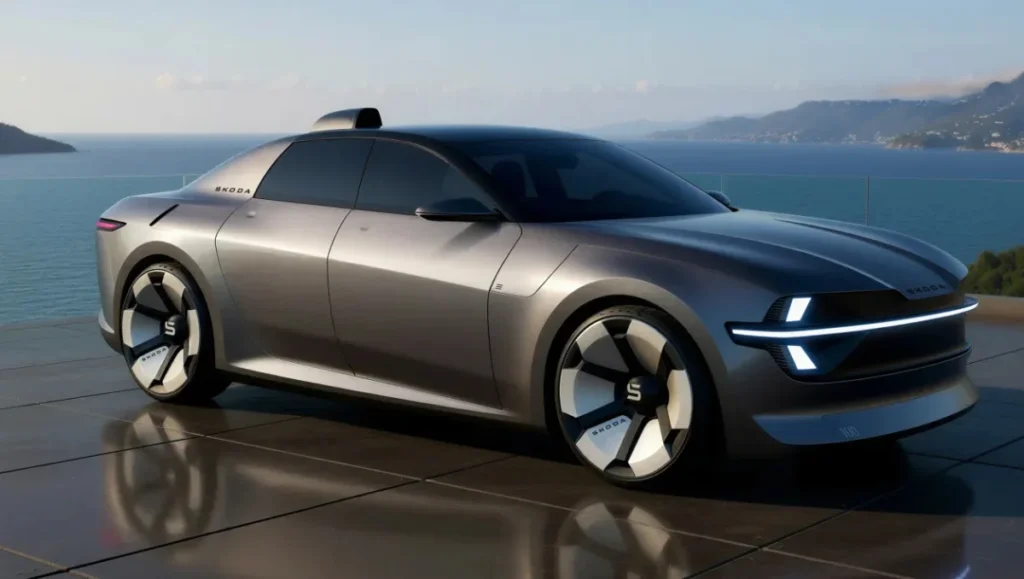
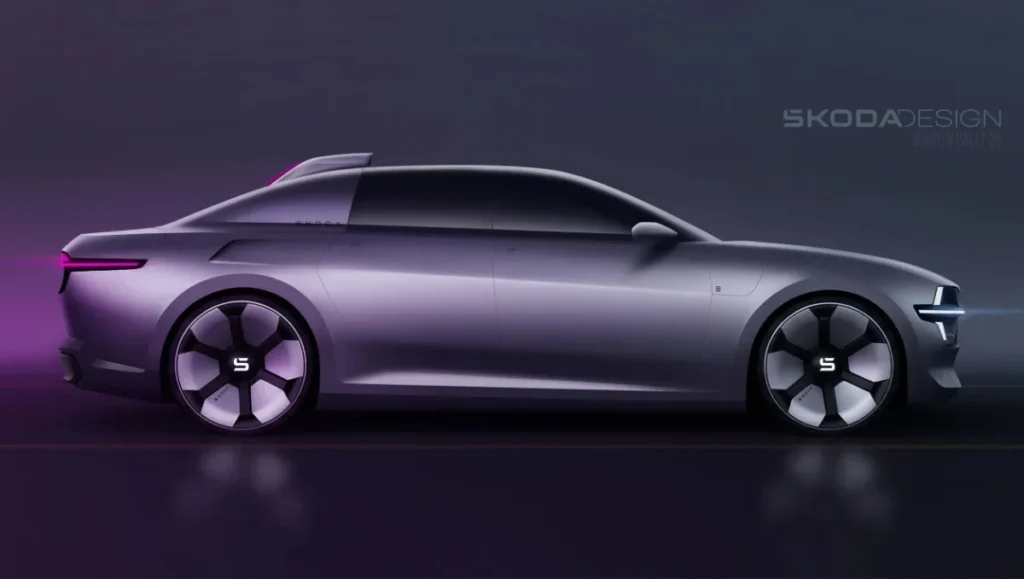
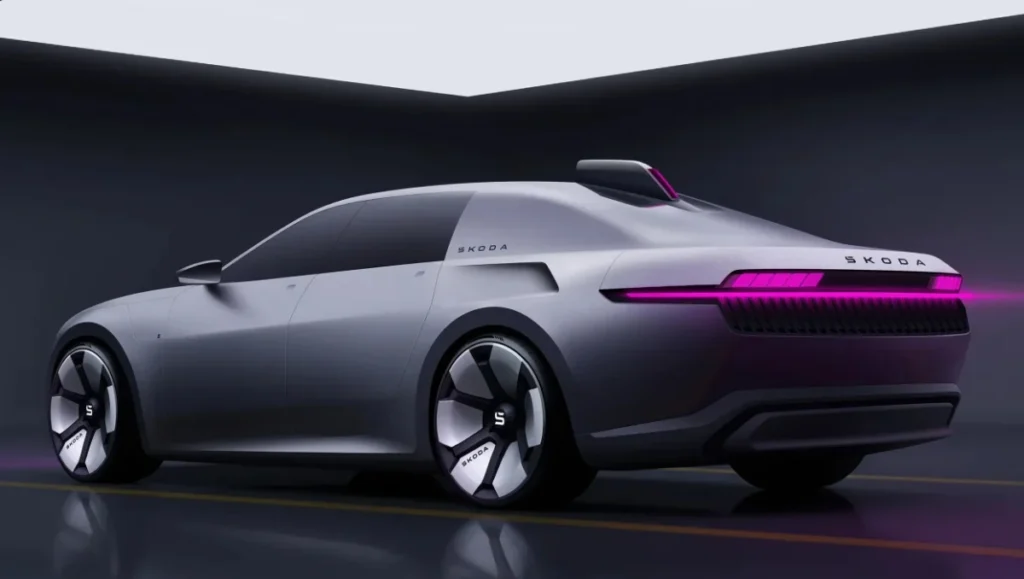
The look of Skoda 100 Concept is a careful balancing act: it hints at heritage yet feels thoroughly contemporary. The bodywork is smooth and sculpted, with large surfaces and broad shoulders reminiscent of modern sedans.
At the front there’s a minimalist fascia — no old-school grille, but a clean face with integrated branding and a distinctive quad-headlamp cluster. That lighting signature nods to the past (the original’s round headlamps and chrome front trim) without copying them directly.
From the side, the profile feels upright and stable: the cabin looks more cuboid than curvy, with a long, almost flat roofline that echoes the 1970s sedan style, yet with modern proportions.
The rear is perhaps the most radical reinterpretation. The concept omits a rear window altogether. In its place is a sleek roof-mounted fin — hiding an air-intake system for cooling the electric drivetrain beneath. On either side of the rear body are subtle vents and structured surfaces reminiscent of the original car’s rear-engine cooling vents.
Lighting too gets a modern reinterpretation: clean LED strips span across front and rear, replacing the classic chrome strips or vents — a subtle tribute rather than a throwback gag.
In short, Skoda 100 Concept blends old and new — forming a bridge rather than a rewind.
How the Concept Works Mechanically (or Doesn’t)
Despite the appearance of a fully-fledged car, Skoda is clear: this is a design study, not a prelude to production. That means no official specs on battery capacity, motor output or range.
Nevertheless, the concept imagines a rear-mounted electric motor driving the rear wheels. That retains the spirit of the original rear-engine, rear-wheel-drive layout — updating it for electric propulsion.
Because there’s no front combustion engine, this design also uses the front area as storage — a “front boot.” A smaller storage space sits behind the rear-mounted drivetrain.
The cooling plan is rethought: instead of old-school engine vents, there’s a roof-intake plus vents near the rear fenders to supply air to the electric components.
But beyond these conceptual choices, technical details remain unconfirmed. The 100 Concept is an artistic exercise — not a prototype.
What This Concept Means for Skoda and Automotive Design
Skoda 100 Concept Unveiled exemplifies how legacy matters — not for nostalgia’s sake, but for identity. Automakers today walk a tightrope between heritage and progress. By choosing not to copy the old 100 verbatim, but reinterpreting it under modern design language, Skoda underlines how heritage can inspire without constraining.
For enthusiasts and general observers alike, this shows that even a humble compact sedan from the 1970s can be re-imagined as a futuristic EV. It prompts a larger question: could other “people’s cars” of the past find new life in the electric age — not as retro revivals but as reinterpretations grounded in modern reality?
For Skoda, this conceptual exercise may not lead to direct production. But the ideas — proportions, rear-drive EV layout, bold lighting treatment — could influence future design directions. A concept car need not hit the roads to shape what the brand stands for.
Why Skoda 100 Concept Unveiled Resonates
In a world filled with hyper-stylized EV crossovers and SUVs, Skoda 100 Concept Unveiled stands apart. It speaks of restraint, balance, practicality — albeit reimagined for 2025 sensibilities. Its design feels honest, not flashy.
For many, there’s emotional value. Vintage car lovers might appreciate how old-school sensibilities get a modern makeover. For younger audiences, it offers a clean, grounded four-door EV concept — a contrast to flashy “tech bros” hypercars.
It reminds us that electric mobility doesn’t need to be loud or aggressive to be relevant. It can be thoughtful, modest, and still forward-looking.
Conclusion
Skoda 100 Concept Unveiled is not about making the past cool again — it is about bridging eras. It pays respect to a humble, widely loved sedan from decades ago, yet casts it forward into a world of electric mobility and modern design. The result is a concept that might never roll off assembly lines, but which can still shape today’s design sensibilities. It shows that history and futurism need not be at odds; they can coexist in harmony, grounded in clean design and careful reinterpretation.
Whether Skoda ever builds a car inspired by this concept matters less than the message it sends: that legacy matters, and that rethinking the old through the lens of the new can create something quietly compelling.
Faqs – Skoda 100 Concept Unveiled
1: What inspired the creation of Skoda 100 Concept Unveiled?
Skoda took inspiration from the original 100 because of its clean proportions and honest design. The goal was not to recreate the old sedan but to reinterpret its simplicity in a fresh EV form.
2: Is Skoda 100 Concept Unveiled going into production?
No. Skoda made it clear that this concept is a design study only. It serves as a creative exploration rather than a prototype aimed at mass production.
3: How closely does the new concept follow the design of the original 100?
The concept keeps the spirit of the classic sedan but avoids retro copying. Details like the upright stance and subtle proportions nod to the past, while the surfaces and lighting stay completely modern.
4: Why does the concept have no rear window?
The design team replaced the traditional rear glass with a sleek fin structure that hides an air intake system. This helps cool the rear-mounted electric drivetrain and gives the concept its unique silhouette.
5: What stands out most about the exterior design?
The minimalist front end with quad lights and the unusual rear design without a window are two of the most talked-about elements. The roof-mounted fin hiding a cooling system also draws attention.
6: Why doesn’t the concept have a rear window?
Since the electric components are mounted at the back, designers used the upper area for an intake system. The idea was functional but also allowed the team to try a bold, uninterrupted rear design.
7: Does the concept have any confirmed technical specs?
No, Skoda has not revealed motor output, range or battery figures. The mechanical layout shown is more of a design imagination than a real engineering blueprint.
8: Is the Skoda 100 Concept Unveiled meant to be a retro car?
Not really. It is more of a respectful nod than a retro revival. The design avoids clichés and instead focuses on capturing the calm, tidy nature of the classic sedan in a modern way.
9: Could elements from Skoda 100 Concept appear in future cars?
Yes, some cues might influence production vehicles. The clean Modern Solid design language, creative lighting approach and potential rear-drive EV ideas could shape upcoming models even if the concept itself stays purely conceptual.
10: Why has Skoda 100 Concept Unveiled gained so much attention?
The concept stands out because it brings a calm, balanced design to an EV world often filled with aggressive styling. Many people also enjoy seeing a familiar, humble classic reimagined in a modern format.
—