JSW Motors to Launch Plug-in Hybrid SUV in June: A Disruptive Entry into India’s Premium Market
The landscape of the Indian automotive sector is standing on the edge of a fairly massive shift as 2026 unfolds. While most of the noise lately has been about pure electric vehicles or the usual “strong hybrids” that we see from established Japanese players, a new contender is preparing to change the conversation entirely. In a move that has caught many industry watchers by surprise, JSW Motors to launch plug-in hybrid SUV in June, marking a significant milestone for the billionaire Sajjan Jindal-led JSW Group. This isn’t just another car launch; it is the formal debut of JSW as an independent passenger vehicle brand, stepping out from the shadow of its joint venture with MG Motor.
For a long time, the Indian car buyer has been caught between two worlds. On one side, you have the internal combustion engine (ICE) which is reliable but increasingly expensive to run. On the other, you have pure EVs which offer low running costs but still trigger a bit of “range anxiety” for those who love long highway trips. The upcoming launch from JSW Motors targets the “goldilocks” zone of this market—the plug-in hybrid electric vehicle (PHEV) segment.
Why the June Launch is a Strategic Gamble
When JSW Motors to launch plug-in hybrid SUV in June, they will be entering a space that is currently almost empty. If you look at the Indian market today, if you want a plug-in hybrid, you usually have to look toward European luxury brands where prices easily cross the one-crore mark. By positioning their first SUV around the ₹45 lakh (ex-showroom) price bracket, JSW is essentially democratizing a technology that was previously reserved for the ultra-wealthy.
The decision to launch in June 2026 is no accident. It puts JSW right in the sweet spot before the monsoon and the big festive season, giving them a few months to get people talking and set up their first few showrooms. What’s really interesting is that they aren’t using the existing MG network at all; JSW Motors is going solo with a brand-new distribution setup to make sure they have their own distinct “home” in the market. This shows a high level of confidence in the product’s ability to pull customers into brand-new showrooms.
JSW Motors to Launch Plug-in Hybrid SUV in June: Technical Details and Design
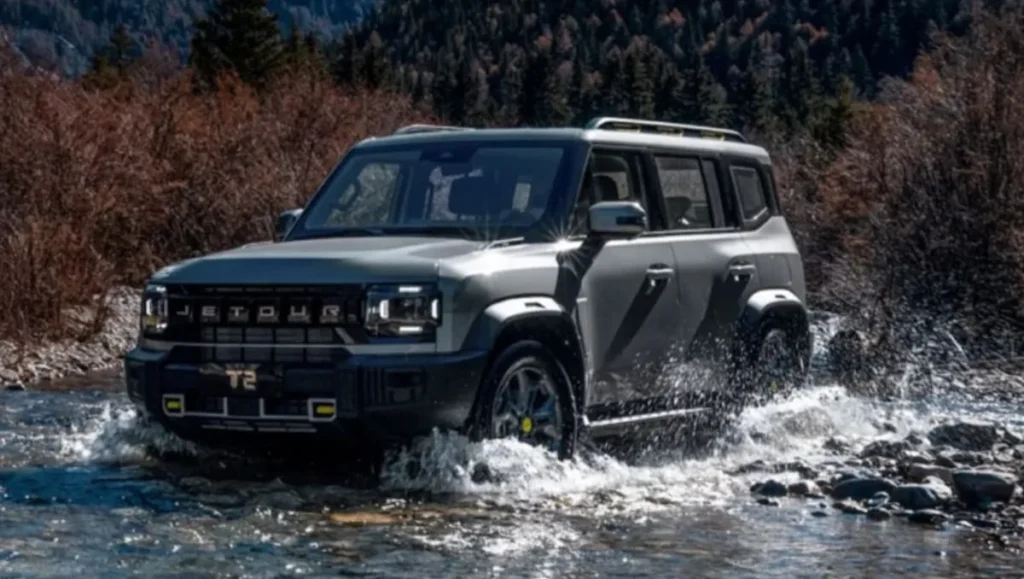
The core of this new vehicle is expected to be a collaboration with international technology partners, specifically leaning on a partnership with Chery Automobile. Word on the street is that JSW’s first SUV will be a localized, rebadged version of the Jetour T2, which is already a big name globally. It’s a smart pick for their debut because the T2 has been a huge hit in places like the Middle East, mostly because it looks tough and actually has the performance to back it up.
JSW is using a smart “dual-power” approach for this SUV. By pairing a 1.5-litre turbo petrol engine with an electric motor, they’ve managed to get 221 bhp and 390 Nm of torque out of the system. It’s a great setup for India because it gives you the muscle of a much larger engine without the high fuel consumption, especially when the car is fully occupied.
The math on the new JSW SUV looks pretty good if you’re a city driver. Because it has that 26.7 kWh battery, the rumored 130 km+ electric range means most owners will rarely need to visit a petrol pump during the week. It’s a smart “multi-tool” approach: use the battery for the short stuff and the engine for the long hauls. It really solves that range anxiety issue while keeping fuel costs way down.
If you like your SUVs to look like they can climb a mountain, you’ll appreciate JSW’s design philosophy. The upcoming model is all about sharp lines and a “boxy and bold” frame, taking some obvious cues from the Land Rover Defender. With its squared arches and vertical front end, it’s a car that screams adventure. It’s a smart move, considering how much Indian buyers love that “go-anywhere” look.
Production and the Maharashtra Connection
A car is really only as good as the place where it’s built, and JSW seems to be taking that very seriously. They’re setting up a massive, 630-acre greenfield plant in Chhatrapati Sambhajinagar to handle production. It’s not just a factory for this first hybrid; they’ve designed it to be a future-proof hub that can switch over to making full electric vehicles whenever the market is ready.
The decision to manufacture locally is critical for the ₹45 lakh price target. By assembling the vehicle in India, JSW can avoid the massive import duties that plague CBU (Completely Built Unit) models from other brands. This local “Make in India” approach also means that spare parts and after-sales service should, in theory, be more affordable and accessible than what luxury European brands currently offer.
The Competitive Landscape in 2026
The June rollout of JSW’s new SUV isn’t going to be easy, as the ₹40-50 lakh space is already dominated by the likes of the Toyota Fortuner and MG Gloster. These are cars that people buy for their sheer presence and diesel grunt. JSW’s plan is to offer that same “big SUV” feel but with a plug-in hybrid setup that makes those traditional diesel engines look a bit outdated.
JSW is essentially gambling on the idea that India is finally ready to ditch diesel. As emission rules get tighter and the world leans more into electric tech, a plug-in hybrid just makes more sense. It gives you that punchy, low-end pull people love in diesels but with the smoothness of a petrol car. Throw in the eco-friendly perks of an EV, and you have a “best of both worlds” SUV that could seriously shake up the market.
Living with a PHEV: The Practicality Factor
For many Indian buyers, a plug-in hybrid is a new concept. Unlike a “strong hybrid” (like the Grand Vitara or Hycross) which you cannot plug in, the JSW SUV will allow you to charge the battery from a standard wall socket or a fast charger.
- City Driving: Pure electric mode for zero-emission commuting.
- Highway Driving: The petrol engine kicks in seamlessly, eliminating the need to stop at charging stations every 300 km.
- Regenerative Braking: The battery recharges itself slightly every time you slow down, improving overall efficiency.
This versatility is likely to be the main selling point when the JSW Motors to launch plug-in hybrid SUV in June officially hits the market. It offers a safety net for those who aren’t quite ready to go “full electric” but want to significantly reduce their carbon footprint and fuel bills.
Final Thoughts on the JSW Motors Entry
It’s rare to see a domestic industrial giant enter the passenger car market with such a high-tech offering right out of the gate. Usually, brands start with budget hatchbacks and work their way up. JSW is doing the opposite—they are starting at the top with a premium, tech-heavy SUV to establish their credentials as a sophisticated automaker.
With the June launch just around the corner, we are bound to see the official name and India-specific details leak out. The anticipation is clearly building across the industry. If the JSW group manages to hit those range targets and keeps the pricing as competitive as rumored, this could easily be the most significant automotive debut we see in 2026.
FAQs – JSW Motors to launch plug-in hybrid SUV in June
1: When is the SUV actually hitting the market?
We’re looking at a June 2026 launch. It’s a pretty strategic move by JSW to get the car into showrooms just before the monsoon and that massive year-end festive buying wave.
2: What kind of pricing are we talking about?
Expect it to land around the ₹45 lakh mark (ex-showroom). Honestly, that’s a bit of a disruptor since most plug-in hybrids in India right now are luxury imports that cost way over a crore.
3: How far can it go on just the battery?
The word is about 130 km to 139 km on a single charge. If your office commute is under 20 km, you could probably go the whole work week without ever needing to use a drop of petrol.
4: Is JSW building this here or importing it?
It’s going to be “Make in India.” They’ve got a brand-new, 630-acre factory coming up in Chhatrapati Sambhajinagar, Maharashtra, specifically for this and future EV models.
5: Is it true this is just a rebadged Jetour T2?
Pretty much. JSW is localizing the Jetour T2 from Chery’s global lineup. It’s already a hit in the Middle East, so they’re bringing that same rugged, “boxy” look to India with a JSW badge.
6: What’s under the hood exactly?
It’s a 1.5-litre turbo petrol engine paired with an electric motor setup. Combined, you get 221 bhp and 390 Nm of torque. That’s plenty of pull for a family SUV, even when it’s fully loaded for a trip.
7: Can I buy this at my local MG dealer?
No, and that’s a big point of distinction. JSW Motors is setting up its own independent showrooms and service centers, totally separate from the existing MG network.
8: How big is the battery compared to a normal hybrid?
It’s much larger. We’re talking about a 26.7 kWh pack. Most “strong hybrids” you see today have tiny batteries that only last for a couple of kilometers; this one is built for actual daily EV driving.
9: Does it take forever to charge?
Not really. While we don’t have the final India charger specs, the global version handles fast charging quite well—going from 30% to 80% in about 30 minutes if you’re at a DC station.
10: Who is this car actually for?
It’s for the person who wants a Toyota Fortuner or MG Gloster but is tired of diesel. You get that same “big car” presence but with the silent, low-cost benefit of an electric vehicle for city use.
—