2026 Renault Duster vs Old Duster: The Icon Finally Grows Up
Renault’s first-gen Duster was a legendary tool for the road, but a disaster in the design department. It was the perfect companion for a mud-caked trail, yet the interior was painfully basic. When it finally bowed out, the Duster was a relic compared to the competition. The industry had shifted to sleek digital interfaces, but the Duster was still dragging around an interior designed two decades ago.
The 2026 model has arrived in Chennai to settle the score. Unveiled on Republic Day, this reboot is a far cry from a basic facelift. The 2026 Renault Duster vs Old Duster comparison is really about old-school muscle meeting modern-day brains. With the CMF-B platform as its foundation, the new SUV wants to prove it’s still a hero on the trail, just a much smarter one.
Design: Trading Curves for Real Attitude
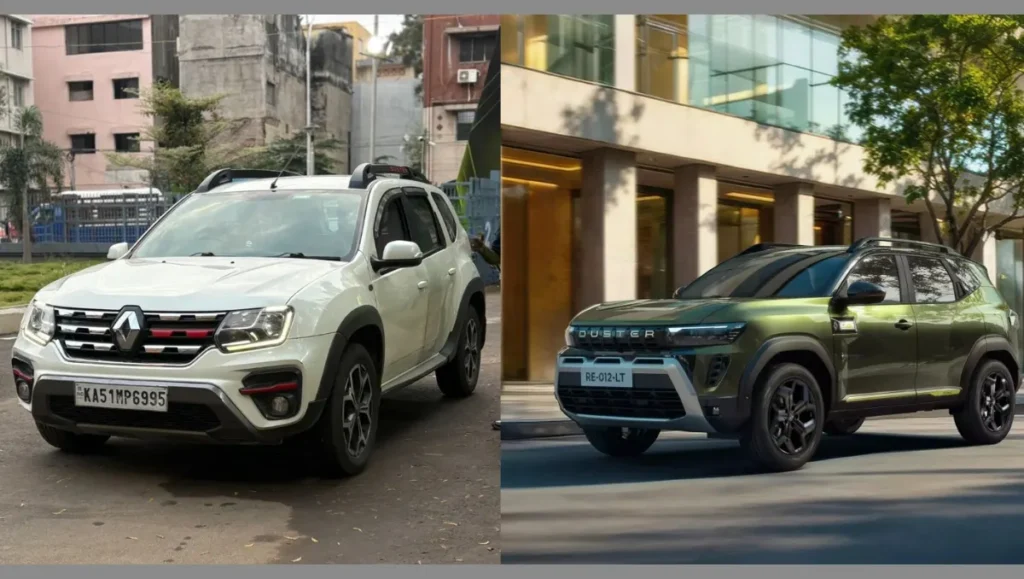
If you park the two side-by-side, the visual jump is staggering. The old Duster was all about those “bulging” wheel arches—a rounded, almost friendly look that suggested toughness. It was a classic, but it was getting soft.
The 2026 Duster has traded its “utility-first” look for something far more athletic. The flat bonnet and “Y-shaped” LEDs give it a modern, tech-heavy appearance that the old halogens never had. A cleaner side profile is achieved by moving the rear door handles up to the C-pillar. Swapping out the 16-inch wheels for 18-inch diamond-cut alloys has transformed the car’s proportions. It looks wider and more substantial now, clearly aiming for a more upscale segment of the market.
The Cabin: A 14-Year Leap Forward
We need to talk about that interior. The old Duster’s cabin was… well, functional. It was a sea of grey, hard plastics. The mirror adjustment knob was hidden under the handbrake, for crying out loud. It was a place you occupied, not a place you enjoyed.
The 2026 cabin is a different story. The new Duster finally puts the driver at the center of the action. You get two big screens—10.1 inches for media and 10.25 inches for stats—but it’s the improved layout that really changes the game. The materials have actually improved. You’ll find textured surfaces, contrast stitching, and—the big one—a panoramic sunroof.
For years, Duster fans were told they couldn’t have a sunroof because of the “rugged roof rails.” Well, the 2026 model proves that was just an excuse. Add in ventilated seats and a powered tailgate, and the 2026 Renault Duster vs Old Duster interior comparison is a knockout in the first round.
| Feature | Old Duster | 2026 Renault Duster |
| Infotainment | Integrated 7-inch Unit | 10.1-inch Floating Touchscreen |
| Cluster | Analog Dials | 10.25-inch Digital Display |
| Materials | Hard Plastics | Textured Layers & Green Accents |
| Smartphone | Wired Only | Wireless CarPlay & Android Auto |
The Performance Puzzle: Where’s the Diesel?
This part might sting for the loyalists. The original 1.5-litre dCi diesel was a real masterclass in engineering, known for its bulletproof reliability and the heavy grunt it offered right from the start. It’s the reason many owners refuse to sell their old cars. But for 2026, the diesel is officially dead.
Turbocharging is the new heart of the Duster family. Leading the charge is the Turbo TCe 160. Squeezing 163 PS and 280 Nm of torque out of a 1.3-litre block, it’s built for spirited driving. On paper, it absolutely smokes the old diesel in terms of speed. It’s punchy and paired with a 6-speed wet-clutch DCT that shifts way faster than the old AMT or manual ever could.
But the real wild card is the 1.8-litre Strong Hybrid E-Tech. This one is for the high-mileage drivers who miss the diesel’s range. It can handle up to 80% of city driving on pure electric power. It’s quiet, it’s smooth, and it doesn’t give you that clattery sound on a cold morning.
Can It Still Get Dirty?
A Duster loses its soul the moment it fails to master a mountain trail. Thankfully, Renault hasn’t turned it into a “mall crawler.” The ground clearance is still a massive 212 mm (and up to 217 mm on some variants).
The 4×4 hardware has finally entered the digital age. With the new “4×4 Terrain Control,” you get five terrain modes at your fingertips, including Snow and Mud/Sand. To make things even more high-tech, there is a dedicated display that shows your vehicle’s pitch and roll angles in real-time. The old mechanical setup was simpler, sure, but the new electronic brains make it easier for a novice to navigate a tricky trail without burning out the clutch. It still has the DNA of a mountain goat; it just went to finishing school.
Safety: No More Compromises
The old model felt like a tank, but it lacked the modern “nanny” tech. The 2026 version doesn’t play around. Safety isn’t an “optional extra” anymore, as Renault has packed six airbags into every single trim. You also get a full Level 2 ADAS suite with 17 different functions, like autonomous braking and a lane-keep system that actually helps on long highway stretches. For a family buyer, this is a massive win. You’re no longer just relying on heavy sheet metal; the car is actually trying to stop you from hitting things in the first place.
The Verdict: A New Price for a New Era
If you look at the 2026 Renault Duster vs Old Duster side-by-side, the answer is a resounding yes, primarily because you are no longer paying for a budget experiment but for a globally competitive SUV. The original Duster was a blue-collar hero, but the 2026 version has clearly graduated to the executive suite with a level of luxury we never thought possible for this brand. Between the 1.8-litre E-Tech strong hybrid system and the panoramic sunroof, Renault has addressed every single complaint owners had about the old, basic model.
It’s an SUV built for an India that is tired of compromising, offering the ventilated seats and panoramic views that the old cabin lacked. While the price has climbed into the 12 to 22 lakh bracket, the trade-off is a machine that feels expensive rather than just expansive. It’s still ready to get muddy on a Sunday, but it won’t feel out of place at a five-star hotel on Monday, which is exactly why the price jump makes sense.
| Feature | Old Duster (1.5L dCi) | 2026 Renault Duster (Turbo TCe 160) |
| Max Power | 110 PS | 163 PS |
| Peak Torque | 245 Nm | 280 Nm |
| Ground Clearance | 210 mm | 212 mm – 217 mm |
| Boot Space | 475 Litres | 518 Litres |
| Safety | Dual Airbags, ABS | 6 Airbags, Level 2 ADAS |
FAQs – 2026 Renault Duster vs Old Duster
1: Is there a diesel option in the 2026 Duster?
No, the legendary 1.5L dCi is gone for good. Renault is sticking with turbo-petrol engines and a strong hybrid to handle the heavy lifting now.
2: What’s the ground clearance like on the new one?
It’s still a mountain goat. You get 212 mm as standard, but some of the 4×4 trims actually sit a bit higher at 217 mm.
3: Does it finally have a sunroof?
Yes, Renault finally listened. The 2026 model comes with a proper panoramic sunroof, something the old version desperately lacked.
4: What kind of mileage can I expect from the Hybrid?
In city traffic, it’s a fuel saver. Renault claims you can do roughly 80% of your urban commuting on battery power alone without touching the petrol tank.
5: How much will the top-end model cost?
While official numbers drop in March, expect the fully loaded 1.3L Turbo or the Hybrid to hit that 22 lakh mark.
6: Is the new 4×4 system better than the old mechanical one?
It’s definitely smarter. The new “4×4 Terrain Control” uses electronic modes for Snow and Mud, so you don’t have to be an expert to get through the rough stuff.
7: Are six airbags standard across the range?
Yes, every single variant gets six airbags right out of the box. Safety isn’t a paid extra anymore.
8: What exactly is the “Turbo TCe 160”?
It’s the performance flagship. It’s a 1.3-litre turbo engine that makes 163 PS, which is way more power than the old Duster ever had.
9: How big is the screen inside?
The main infotainment is a 10.1-inch floating unit. It’s paired with a 10.25-inch digital dash for the driver, so the cabin finally feels like it belongs in 2026.
10: When can I actually buy one?
Bookings are open now for 21,000. If you want the Turbo, expect it in April, but you’ll have to wait until Diwali for the Hybrid.
—