Field Notes: Arctic Circle – Range Rover Velar EV (Feb 28, 2026)
Scandinavia in late February offers a bone-dry cold that literally bites at your lungs. It’s the kind of weather that kills camera batteries in three minutes flat and makes every plastic trim piece of the Range Rover Velar EV Spied prototypes groan like a haunted floorboard. I’ve spent a decade tracking “dazzle” camouflaged test mules near the Arctic Circle, and you eventually learn to hear the shift in the industry before you see it. When a convoy hums past in near-perfect silence, kicking up plumes of powder without a single puff of exhaust, you know the internal combustion era is being buried in the snow.
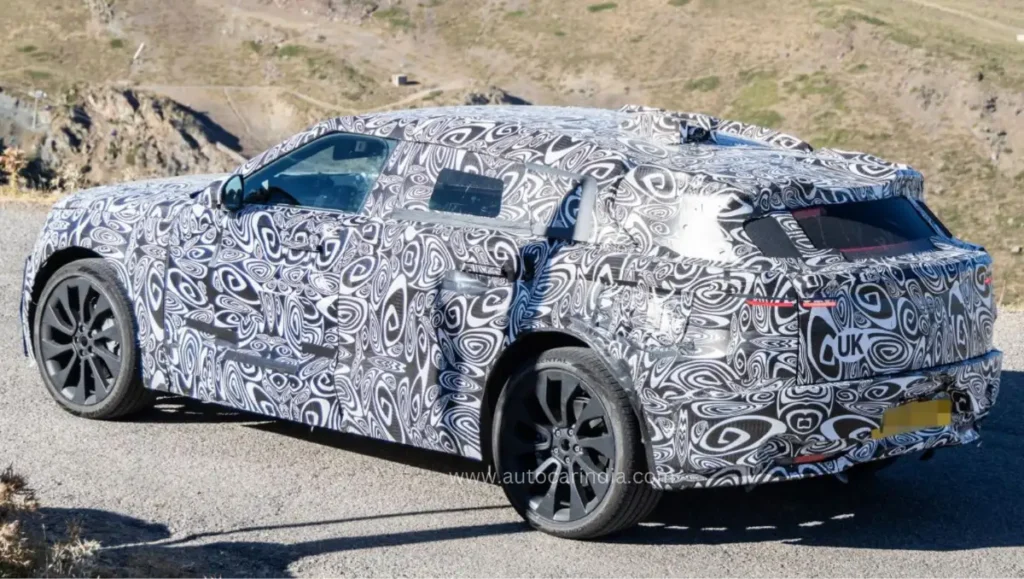
As of February 28, 2026, the most significant “something” in the luxury sphere is the Range Rover Velar EV Spied undergoing final calibration in these brutal, sub-zero conditions. This isn’t just a mid-cycle update. It’s a total rejection of the “upright brick” silhouette that has defined Range Rover for half a century.
The Velar was always the “pretty” sibling. The one you bought for the aesthetics, not the wading depth. The “Goldilocks” car. After tracking the latest Arctic runs on February 27 and 28, 2026, it’s obvious the old SUV playbook is dead. JLR is pivoting to a high-riding, ultra-sleek fastback that looks more like a grand tourer on stilts. It’s low. It’s wide. It’s angry.
The “Road Rover” Ghost Materializes
A decade-old whisper still haunts the Gaydon halls: the “Road Rover.” The internal goal for this ghost project was simple—build a vehicle that prioritized tarmac manners and aerodynamics, leaving the heavy mud-plugging to the Defender. Looking at the Range Rover Velar EV Spied images from this week, the “Road Rover” has finally arrived. Even if it wears a Velar badge to keep the marketing department happy.
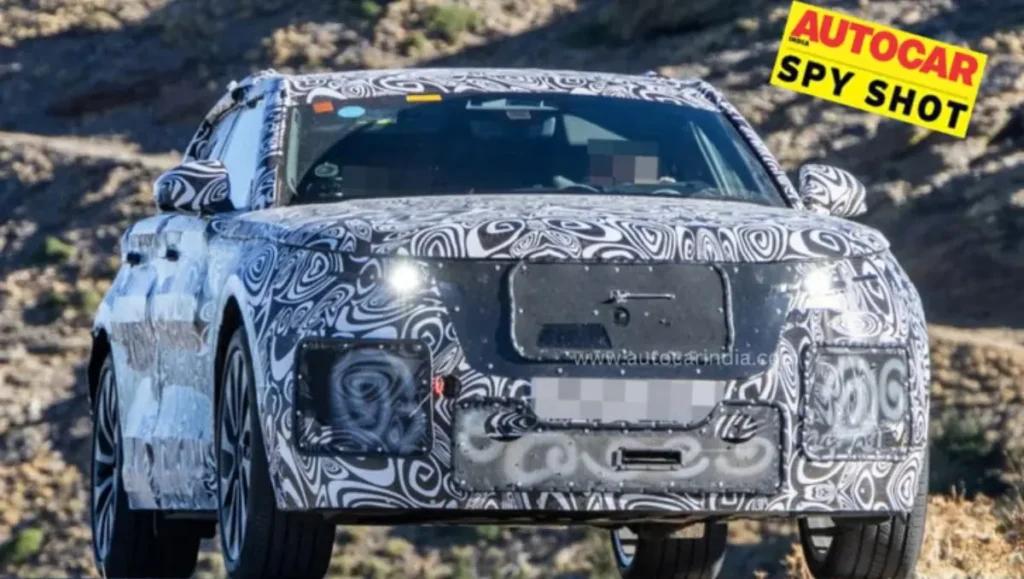
The most jarring change? The ride height. This thing sits incredibly low for anything wearing a Land Rover badge. The roofline just falls off after the B-pillar, creating this sharp, aggressive rake that’s pure shooting brake. In this 2026 EV climate, drag is the absolute enemy of range. To compete with the Porsche Macan EV on a level playing field, JLR realized they couldn’t just stick a battery into a box. By lowering the nose and smoothing the tail, they are clawing back every possible mile of efficiency.
The Missing Window: A Gimmick or a Revolution?
One detail from the February 2026 spy shots has caused more debate in the pits than anything else: the rear hatch. If you look closely at the test mules, the rear end looks strangely solid. Industry whispers—and my own observations of the roof-mounted camera fin—suggest the Velar EV might follow the Polestar 4’s lead and eliminate the rear glass window entirely.
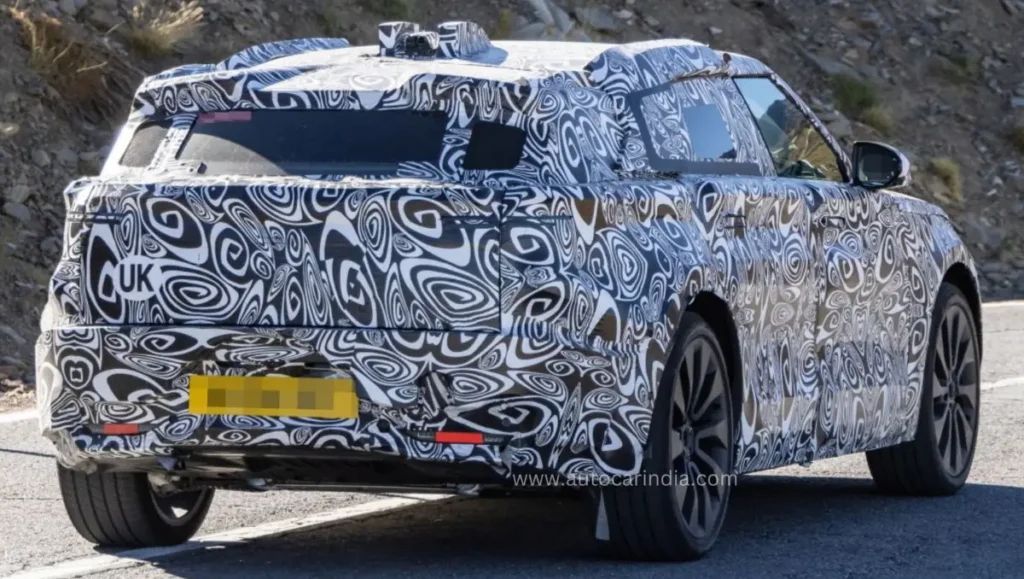
The logic is sound. Packaging. Ditching the glass lets engineers shove structural beams way back, carving out huge rear headroom despite that aggressive, raked roof. You won’t miss the window; a hi-def digital screen fed by twin roof-fin cameras handles the rear-view duties perfectly. It’s a polarizing choice. A “love it or hate it” design move. Frankly, Range Rover needs that kind of edge right now.
Range Rover Velar EV Spied: The EMA Revolution
While the exterior gets the headlines, the real story is the hardware hiding under that “dazzle” wrap. This isn’t a “legacy” platform adapted for batteries like the current Range Rover Electric. The Velar EV is the standard-bearer for the Electrified Modular Architecture (EMA).
This is a “born-electric” foundation. Because it was never intended to house a gas engine, the engineers pushed the wheels to the absolute corners. You can see it in the Range Rover Velar EV Spied photos—the front and rear overhangs are almost non-existent. This gives the car a planted, wide-track stance. The real benefit is inside. Despite the coupe-like exterior, the interior floor is entirely flat, potentially creating more legroom than you’d find in a current Range Rover Sport.
800-Volt Power and the “Espresso-Driven” Charge
Because the EMA is a next-generation platform for 2026, it’s built around an 800V system. If you’re looking for the most vital number on the sheet, this is it. The Velar EV is designed to ingest power at speeds of up to 350kW, making high-voltage pit stops a total non-event.
Imagine a typical February road trip. You find a rapid hub, plug in, and by the time you’ve downed an espresso and paced the lot, you’ve added 150 miles of juice. We’re talking 10% to 80% battery capacity in approximately 20 minutes. This effectively kills “range anxiety” for the luxury buyer. If you can charge that fast, you don’t need a massive, heavy battery that ruins the handling.
The target is 500km to 720km (310–447 miles) on a single charge. This EMA-based range puts the Velar right at the sharp edge of the market, prepped to go toe-to-toe with the Audi Q6 e-tron and the fastest Macan EVs.
Performance: More “Sport” than “Utility”
The Velar has always been the most car-like Range Rover in the stable, but the EV version is doubling down on that DNA. It’ll handle a brutal Arctic blizzard better than most rivals, but the Range Rover Velar EV Spied footage proves its true heart is a winding B-road.
- Twin-Motor Precision: Expect a dual-motor setup across most trims. Since these electric units tweak torque in literal milliseconds, the grip on a rain-slicked mountain pass is going to be a total revelation.
- Instant Acceleration: The top-trim motors are aiming for a 0–60 mph time under 4 seconds. It is that ghostly, massive wall of acceleration that defines the 2026 luxury experience.
- Intelligent Torque: JLR’s new software replaces traditional ABS-based traction control. It can send power to an individual wheel in just 1 millisecond—roughly 100 times faster than a human can blink.
A British Production Story in Halewood
There’s a significant element of British industrial pride involved here. The Velar EV will be the first electric model to roll off the lines at the Halewood plant in Merseyside. JLR has poured over £500 million into that factory to transform it into an EV-only hub.
The batteries aren’t coming from across the globe, either. They will be supplied by the new Agratas gigafactory in Somerset—a massive project by the Tata Group that hit a major milestone with the steel frame completion on February 12, 2026. JLR’s engineering team is pushing 120kWh from a mere 342 liters of cell volume—a massive density leap over the old I-Pace’s 84kWh/387-liter footprint. By locking down the battery tech and the local Halewood lines, they’re ensuring the Range Rover Velar EV Spied prototypes feel like authentic luxury machines, not just a generic EV with a slapped-on badge.
Why the Velar Matters in 2026
In the February 28, 2026 landscape, the Velar EV is the most important hardware JLR has ever shipped. It is the lead scout for the EMA platform, a dedicated electric foundation that finally allows for the flat floors and short overhangs that ICE platforms simply couldn’t handle. With over £500 million poured into Halewood’s EV conversion, this car is the industrial proof that the UK can actually compete in the high-spec battery race.
Rivals in Stuttgart are already running forensic diagnostics on the Range Rover Velar EV Spied clips, hunting for aerodynamic weaknesses. But with a targeted 720km range and software that adjusts torque 100 times faster than a human blink, the Velar is rewriting the rulebook. It matters because it takes the brand out of the “legacy SUV” category and drops it squarely into the futuristic, high-performance EV arena where charging speeds and drag coefficients are the only metrics that count.
Final Thoughts on the Future
Every dithered pixel of that Range Rover Velar EV Spied footage is currently undergoing a frame-by-frame autopsy by Gaydon insiders and Stuttgart rivals. From the flush door handles to that mysterious solid rear hatch, everything about this car screams “the future.” After the Velar, we will see an electric Evoque and an electric Discovery Sport, but the Velar is the one leading the charge. It’s a brave move for a brand with so much history, but based on what we’ve seen in the snow this February, it’s a move that might just pay off.
FAQs – Field Notes Range Rover Velar EV Spied
1: What range is JLR targeting for the Velar EV?
The EMA hardware is aimed at 500km to 720km (roughly 310–447 miles). This range-depth depends on the 800V thermal management and specific dual-motor trim levels.
2: How quick is the charging on the new 800V rail?
It’s built for 350kW DC rapid charging.
In real-world terms: you’re looking at a 10% to 80% juice-up in just 20 minutes, adding 150 miles in the time it takes to grab an espresso.
3: Is the “no rear window” rumor true?
The latest Range Rover Velar EV Spied footage shows a solid rear hatch. JLR is ditching the glass for a roof-mounted camera fin and a digital rearview mirror to improve aero-drag and rear headroom.
4: Where is JLR building this new electric SUV?
Assembly is locked in for the Halewood plant in Merseyside. JLR dropped over £500 million to gut the factory and install 750 autonomous robots for this specific EV-only rollout.
5: What makes the EMA platform different from the old I-Pace?
EMA is a “born-electric” skateboard. Unlike the I-Pace’s legacy tech, this architecture allows for 120kWh of power in a tiny 342-liter footprint, maximizing cabin space and floor flatness.
6: Will it handle 0–60 mph faster than a Macan EV?
Top-spec EMA builds are hunting a sub-4-second 0–60 mph sprint. The goal is instant, silent torque that rivals the high-performance Porsche and Audi Q6 e-tron variants.
7: What’s the deal with the “Road Rover” nickname?
It’s a decade-old Gaydon ghost project. The Velar EV is the “Road Rover” come to life—a vehicle that prioritizes tarmac manners and low-drag over the Defender’s traditional mud-plugging.
8: When did the Agratas battery factory reach its latest milestone?
The Somerset-based Agratas gigafactory hit its “steel frame completion” milestone on February 12, 2026, securing the local supply chain for the Velar’s high-density cells.
9: How does the torque management work in the snow?
JLR’s new 2026 software stack adjusts power in just 1 millisecond. It’s 100 times faster than a human blink, allowing for precise wheel-slip control on wet or icy B-roads.
10: Is this just a renamed Range Rover Sport?
No. This is a clean-sheet design. It’s lower, wider, and more aerodynamic than any current Range Rover, signaling a total pivot toward the ultra-sleek fastback market.