Hyundai CRATER Concept Breaks Cover at AutoMobility LA with Extreme Off-Road Vision
The moment has arrived: the Hyundai CRATER Concept breaks cover and introduces a fresh vision of what an adventurous compact SUV could be. Hyundai CRATER Concept breaks cover. On the surface it’s a concept vehicle, but the deeper story is about how it signals a shift in how this manufacturer imagines future off-road capable EVs. The SUV world is full of models that look rugged in marketing photos; this one tries to make the appearance mean something.
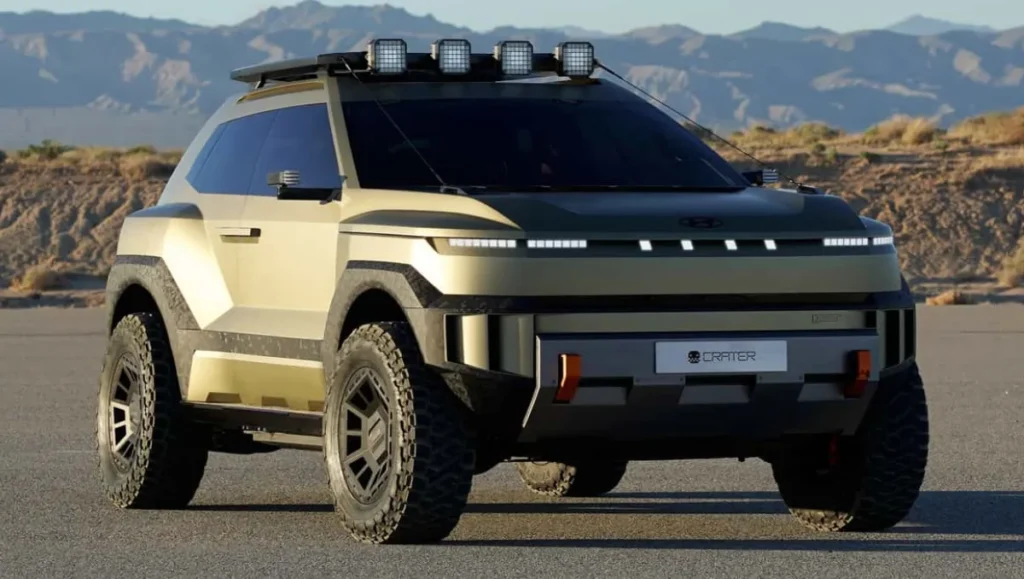
The bold debut of Hyundai CRATER Concept breaks cover
When the Hyundai CRATER Concept first appeared at the AutoMobility LA 2025 event, it immediately caught attention for being rugged, purposeful and quite different. Hyundai says this concept, developed at their Irvine, California design and tech centre, is meant to push the limits of what their “XRT” off-road sub-brand could evolve into. In simple terms: the Hyundai CRATER Concept breaks cover and says “we’re serious about adventure.”
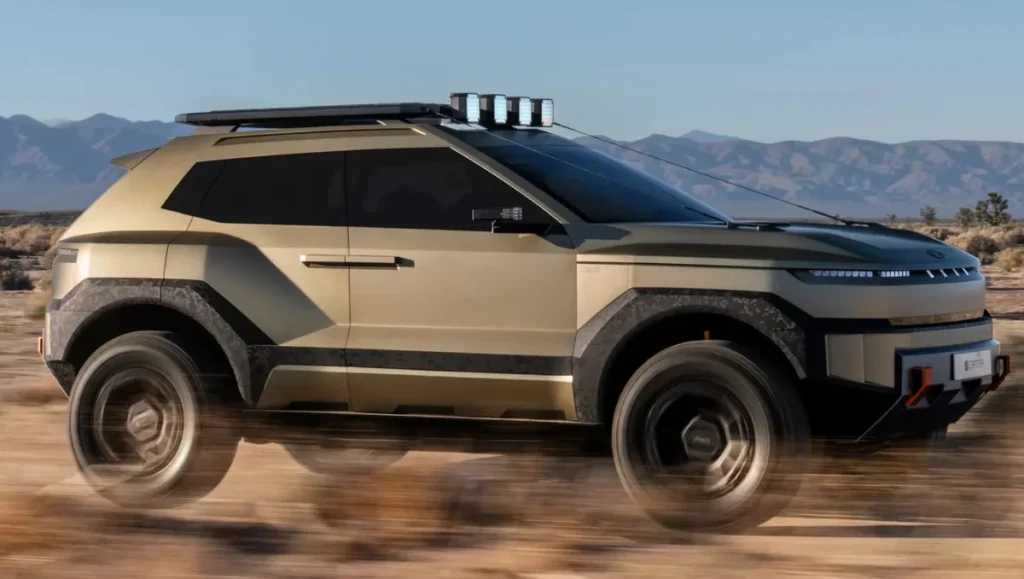
The design clearly favours ruggedness. Short overhangs and solid skid plates sit beneath bold bodywork, while the wide arches pack in 18-inch wheels and big 33-inch tyres, lifting it high and making it look trail ready. The design was guided by Hyundai’s “Art of Steel” exterior design language—sharp forms, crisp steel-inspired surfaces, bold sculpting around the fenders.
Inside, the cabin is no luxury lounge but a functional adventure space: built-in roll cage elements, seats with wraparound forms and four-point seatbelts, a full-width head-up display, and removable side-cameras that double as flashlights. The interior styling leans into durability and utility, with surfaces that are meant to be used rather than simply looked at.
Design details that stand out
One of the most eye-catching features of the Hyundai CRATER Concept is how many little touches reinforce the “go anywhere” story. The 33-inch tyres fit over massive wheel arches, the bumpers are cut high for better approach and departure angles, visible skid plates line the underside, and features like roof-mounted auxiliary lights and a roof-platform suggest gear hauling and outdoor excursions.
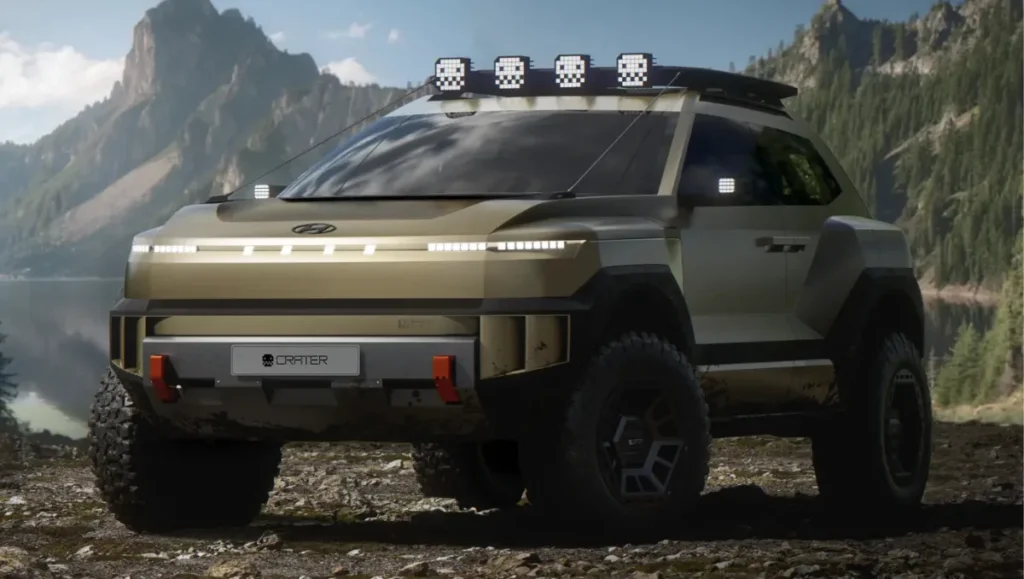
Lighting is distinctive: the vehicle uses Hyundai’s pixel lighting motif, including lights integrated beneath the badge and subtle three-dimensional lighting elements in the body. Side view cameras replace traditional mirrors, but these cameras are detachable and can be used as a torch or recorder—an adventurous gimmick yes, but it adds to the overall narrative. The wheels themselves are inspired by the idea of a hexagonal asteroid hitting metal, leaving a crater—hence the name. All this means the Hyundai CRATER Concept breaks cover as something more playful, more expressive than many concept cars which simply go futuristic.
On the colour and material side, the body uses a matte “Dune Gold” paint (in some descriptions) with accents of black and anodised orange touches. The interior uses durable materials: black leather, Alcantara, brushed metal, topographic patterns etched into surfaces to evoke terrain. The design team clearly thought hard about what “explore” could mean in an SUV.
What it hints about future capability
While the Hyundai CRATER Concept breaks cover and is spectacular to look at, what’s more interesting is what it hints about Hyundai’s direction. the vehicle has genuine off-road cues. Locking front and rear differentials, terrain modes marked Snow, Sand, Mud, and the notion of downhill brake control suggest serious intent. The architecture is a compact monocoque, though the concept may stay concept; but the idea is to show what future XRT models could become.
Even though precise powertrain specs aren’t revealed, indicators point to it being an electric vehicle (EV) or at least EV-based: the closed grille, the design lineage, the brand’s push in electrification all suggest that this is part of a move toward rugged EVs. So when we say Hyundai CRATER Concept breaks cover, we also mean it breaks into new territory for the brand: combining off-road ruggedness with EV or electrified capability.
For markets like India, this is especially interesting. Although no specific India launch is announced, such an SUV philosophy could speak to buyers who want more than the average compact SUV—they want style, adventure, and off-road readiness (even if they never take it off-road). Hyundai’s expanding model plans hint that some elements of the concept may filter down.
Why it matters (even if production is uncertain)
Concept vehicles are often more about signalling than production readiness. The Hyundai CRATER Concept breaks cover not just as a show car, but as a statement. It says: “we are willing to play in the off-road space, we are willing to make rugged EVs, and we are willing to have fun while doing it.”
For customers, this matters because it widens expectation. If the styling and capability cues from this concept find their way into production vehicles, then buyers could get SUV models that are tougher, more adventurous. For technology watchers, the detachable side cameras, the BYOD (bring your own device) interior interface, and the playful “Crater Man” mascot embedded in design are signs of how automakers are injecting personality into utility vehicles.
Even if the Hyundai CRATER Concept in its full form never hits production, the concept will influence design, engineering and marketing of future models. So for Hyundai’s global brand, especially in markets where off-road culture is growing or adventure lifestyle is valued, this concept is a blueprint.
Potential challenges and what to watch
Of course, concept to production often means compromises. High ground clearance and large off-road tyres may impact ride comfort, noise, cost, and efficiency. Features like removable camera-flashlights are fun, but may be trimmed in production. The price will likely rise if the rugged hardware is real. For Indian market relevance, cost sensitivity and road conditions matter. If Hyundai introduces a production derivative, balancing ruggedness with affordability will be key.
Also, actual powertrain details are vague. If it is EV-based, charging infrastructure and battery cost in India will affect success. While the design is bold, real-world usability will need to match expectations—things like off-road electronics, durability, service network for specific parts all become factors.
For now though, the Hyundai CRATER Concept breaks cover. The question going forward will be: how much of this concept makes it into the showroom, and how well it adapts to real-world needs.
In summary
The Hyundai CRATER Concept breaks cover with a striking mix of rugged design, tech-driven interior, and off-road credentials that feel more than skin-deep. It tells you the brand is ready for new adventures, on the dirt and in the bigger picture of where it’s heading. For fans of adventure SUVs and emerging EV-rugged combinations, this concept deserves attention. As we watch Hyundai’s model pipeline, the influence of the Crater concept may well show up within a few years in production vehicles that bring a little of this bold spirit to regular roads.
Faqs – Hyundai CRATER Concept breaks cover
- What’s the Hyundai CRATER Concept supposed to be anyway?
It’s basically Hyundai showing off an idea of a small but rugged SUV. Not something you can buy yet, more like a glimpse of what they might build if people like the direction.
- Where did they reveal it?
They pulled the covers off at the AutoMobility LA event. From what people said online, it stood out pretty quickly because it looked a lot tougher than most compact SUVs.
- Is this an actual production car?
No, not for now. It’s still a concept. These usually go through a ton of changes before any real version ever hits the market, if it even gets that far.
- Is it electric or not?
Hyundai didn’t spell out every detail, but the design hints strongly at it being electric or at least some kind of electrified setup. The closed-off front end kind of gives it away.
- Why does it look so hardcore?
Because Hyundai clearly wanted it to look like it can handle rough tracks. The short overhangs, chunky tyres, and heavy skid plates make it feel like they really leaned into the off-road vibe.
- Is there any chance it comes to India later?
Nobody has confirmed anything yet. Hyundai sometimes brings global ideas to India in a toned-down form, so it’s possible the design influence might show up in future models.
- What’s going on with the cabin?
The interior looks more like something made for adventure trips. Strong seat frames, roll-bar kind of elements, and those quirky removable side cameras that you can use like a torch… it’s not the usual clean city SUV layout.
- Why did they name it “Crater”?
The name seems tied to the theme of impact and rugged surfaces. Some parts of the wheels and body panels follow that crater-like design idea, so the name kind of fits.
- How is it different from the usual compact SUVs we see around?
Most compact SUVs are city-friendly first, adventure-second. This one flips that around — it looks like it was imagined for trails and rough use more than school runs and office commutes.
- Will the final model look like the concept?
Probably not exactly. Concepts always look more aggressive and experimental. If Hyundai builds something based on it, it’ll likely be a more practical, toned-down version.
—