India-Made Suzuki Baleno’s Latin NCAP Result Raises Serious Safety Questions
India-Made Suzuki Baleno Gets 2 Stars in Latin NCAP. Recent attention around its Latin NCAP performance has put that balance under scrutiny. The latest crash test result does not come as a shock to many observers, yet it still raises important questions about expectations in modern cars. Buyers today look beyond features and price, paying closer attention to real-world protection.
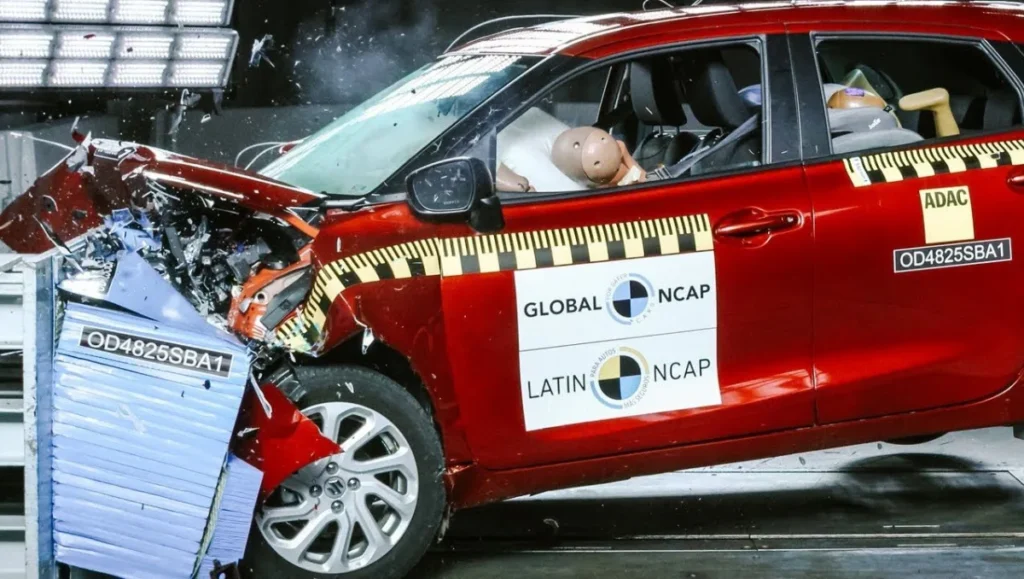
The India-Made Suzuki Baleno Gets 2 Stars in Latin NCAP rating comes from tests carried on the updated export model, the one that now has six airbags as standard. On paper, that feels like a decent step. In practice, the data shows adding airbags alone does not automatically result in a strong safety rating under today’s testing standards applied.
What Exactly Was Tested
Latin NCAP looks at vehicles that are actually sold across Latin American and Caribbean markets. The Baleno evaluated here was manufactured in India and exported in the same specification offered to buyers in that region. This matters because NCAP does not test optional upgrades or theoretical versions. It tests what customers actually get.
The crash tests included frontal offset impact, side impact, and assessments for pedestrian safety. Adult occupant protection and child occupant protection were both considered for the final score. An overall result of 2 stars signals limited protection when judged by modern expectations, although the car is still fairly current in age and general design.
In frontal impact test, airbags deployed as expected and helped reduce head injury risk. That part worked as intended. The problem areas showed up elsewhere. Chest protection for both the driver and front passenger was rated as marginal. Forces recorded in the leg area were also higher than ideal, which increases the likelihood of injury in real-world crashes.
The bodyshell was described as unstable. This is a critical detail. An unstable bodyshell means the structure does not manage crash energy efficiently once impact forces rise beyond a certain point. It does not mean the car gives up instantly, but it points to limited margin once collisions become more severe.
Why India-Made Suzuki Baleno Gets 2 Stars in Latin NCAP
There is no single reason behind the rating. The India-Made Suzuki Baleno Gets 2 Stars in Latin NCAP outcome is the result of several factors working together, or not working well enough.
The addition of six airbags helped, especially in frontal and side impacts. However, electronic stability control was not standard on the tested model. Under current NCAP protocols, this feature still matters a great deal in scoring outcomes. Stability control helps prevent crashes before they occur, especially during sudden steering inputs or unexpected loss of grip.
Side impact protection, while improved, still showed limitations. The door structure and side body panels did not absorb impact energy as effectively as higher-rated vehicles. This affected injury readings, particularly in the torso area.
Pedestrian protection also pulled the score down. The front bumper and bonnet design offered limited cushioning. Latin NCAP places growing importance on pedestrian safety, especially in regions where mixed traffic conditions are common.
All these areas combined explain why the final rating remained at 2 stars despite safety upgrades.
How This Fits with Baleno’s Image
The Baleno has never been marketed as a safety benchmark. Its appeal lies elsewhere. Space, fuel efficiency, ease of driving, and brand familiarity are what usually bring buyers to the showroom. Because of that, many owners assume the car is reasonably safe simply because it sells well.
The India-Made Suzuki Baleno Gets 2 Stars in Latin NCAP result challenges that quiet assumption. Popularity alone is not protection. Meeting regulations does not mean going further. The Baleno complies with safety norms, but independent testing shows compliance by itself still leaves gaps.
This is not unique to Suzuki, but when a model sells in large volumes, the spotlight becomes brighter. Crash test results feel more personal because so many people already own or plan to buy the car.
Export Impact and India’s Role
India’s role as a global manufacturing hub continues to grow. Cars built here are shipped to many regions with different safety expectations. The India-Made Suzuki Baleno Gets 2 Stars in Latin NCAP outcome highlights ongoing discussion about how Indian-made vehicles are evaluated outside domestic markets globally.
Some manufacturers made quick changes, reinforcing structures and fitting safety systems into lower-priced models. Others have taken a slower approach, focusing on cost control and features that are easier to market.
NCAP scores increasingly influence buyer trust, especially in export markets where safety awareness is rising. A modest rating does not end sales overnight, but it does shape perception over time.
What Buyers Should Realistically Take From This
For buyers in Latin America, the India-Made Suzuki Baleno Gets 2 Stars in Latin NCAP score should be seen as information, not alarm. The car is not unsafe in a legal sense. It can be driven daily without issue, just like millions of others on the road.
However, the rating does indicate higher injury risk in serious crashes compared to vehicles with stronger structures and more advanced safety systems. Buyers who put safety ahead of everything else may want alternatives or compare NCAP scores properly.
Families especially should pay closer attention to child occupant protection. While child seats can be installed properly, the overall protection level remains limited under severe impact conditions.
Is Improvement Still Possible
Yes. The India-Made Suzuki Baleno Gets 2 Stars in Latin NCAP score is not permanent. Manufacturers can and do improve ratings by updating safety equipment and structural design.
Making electronic stability control standard would be a significant step. Further reinforcement of the bodyshell and better side impact management would also help. Pedestrian protection can be improved through relatively small design changes if prioritized early.
Other cars in similar price ranges have already shown better safety is possible without pushing costs up too much. Whether Suzuki goes further will come down to market pressure and how regulations change.
Closing Thoughts
India-Made Suzuki Baleno Gets 2 Stars in Latin NCAP sits away from failure, though success story is not the right label. It lands in the middle, showing a car that has improved but not enough for modern safety expectations.
The Baleno is one of those cars you notice feels familiar almost everywhere. It sells in big numbers, looks modern enough, and is usually associated with efficiency and ease of ownership. Safety, however, has never been its strongest talking point, and this latest crash test rating reinforces that reality.
For buyers, this result adds context. For manufacturers, it acts as a clear signal that safety cannot remain optional or secondary anymore. As testing standards keep getting stricter, the difference between acceptable and truly safe will stand out more clearly.
FAQs – India-Made Suzuki Baleno Gets 2 Stars in Latin NCAP
FAQ 1: What does the 2-star Latin NCAP rating mean for the Suzuki Baleno?
It means the tested version of the Baleno offers limited protection compared to current safety expectations, especially in more severe crashes.
FAQ 2: Which version of the Baleno was tested by Latin NCAP?
Latin NCAP tested the updated export version made in India, which comes with six airbags as standard.
FAQ 3: Is the Baleno unsafe to drive because of this rating?
No. The car meets legal safety requirements and can be driven normally, but it does not offer high crash protection by modern standards.
FAQ 4: Why did the Baleno score only 2 stars despite having six airbags?
Because airbags alone are not enough. Structural strength, electronic stability control, and pedestrian protection also affect the final score.
FAQ 5: Did the airbags work properly during the crash test?
Yes. In the frontal crash test, airbags deployed correctly and helped reduce head injury risk.
FAQ 6: What were the main weak areas in the crash test?
Chest protection, leg protection, side impact performance, pedestrian protection, and overall structural stability were key concerns.
FAQ 7: Does this Latin NCAP result apply to the Baleno sold in India?
The tested car was an export model, but the platform and structure are similar, so the result still offers useful context.
FAQ 8: How important is electronic stability control in NCAP ratings?
It plays a major role. Stability control helps prevent accidents before they happen and heavily influences modern NCAP scores.
FAQ 9: Should families be concerned about this rating?
Families should pay closer attention to child occupant protection and consider NCAP results when comparing options.
FAQ 10: Can Suzuki improve the Baleno’s safety rating in the future?
Yes. Adding stability control as standard, strengthening the bodyshell, and improving side and pedestrian protection could raise the score.
—