India’s Vehicle Exports Reach Record Levels in FY2025-26
India’s vehicle exports are seeing a never-before boom, making India a global automotive leader. India exported a record 31,43,224 vehicles in the first half of FY2025-26 alone, a whopping 24 percent growth in comparison to the corresponding period last year. This achievement reaffirms India’s increasing dominance as a center for low-cost, high-quality, and sustainable vehicle production.
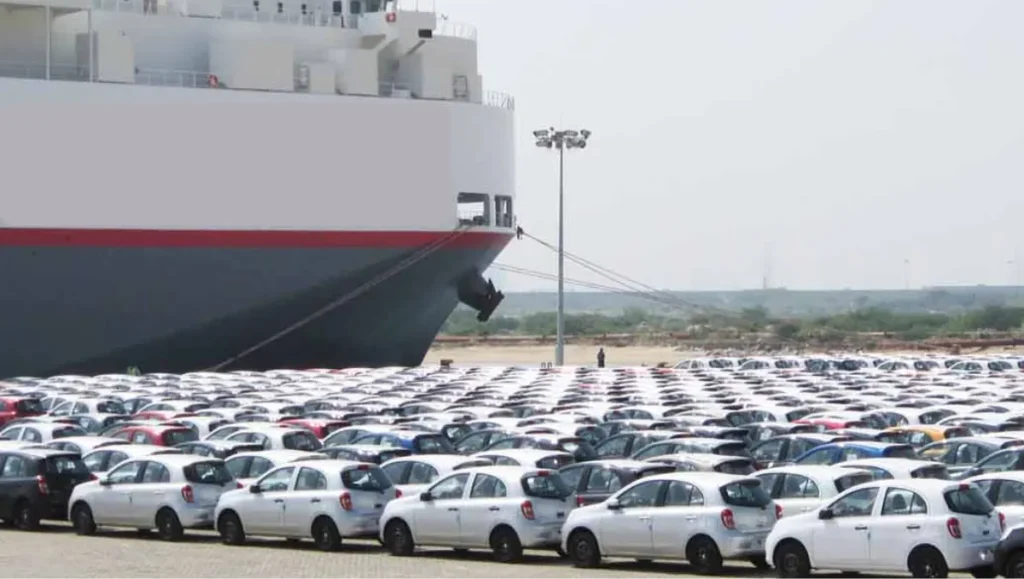
As per the Society of Indian Automobile Manufacturers (SIAM), India’s automobile exports growth is on a broad base that includes passenger cars, two-wheelers, three-wheelers, as well as commercial vehicles. The statistics unmistakably show Made-in-India cars gaining growing popularity in global markets, starting from Latin America and Africa to Southeast Asia and the European continent.
Passenger Vehicle Exports Reach Record High
Passenger vehicle segment continues to be a growth driver for India’s automobile exports, with the overall shipments totaling 4,45,884 units in H1 FY2026, or 18 percent higher compared to the previous year.
In this segment:
• Passenger cars stood at 2,29,281 units, up by 12 percent.
• Utility vehicles climbed 26 percent to 2,11,373 units.
• Vans witnessed a spectacular 37 percent increase to 5,230 units.
Taking the lead is Maruti Suzuki India, having shipped out 2,05,763 vehicles in six months—a record 40 percent spike over last year. The company’s maiden electric export model, the e-Vitara, has already started shipping abroad even before its local launch. Hyundai Motor India followed suit, shipping 99,540 units, a 17 percent year-on-year growth.
These statistics point out how Indian car exports in the passenger vehicle segment are riding high on innovation, dependability, and cost-effective manufacturing.
Two-Wheeler Exports Powering Ahead
Two-wheeler segment remains the pillar of India’s automobile exports and contributes to almost 77 percent of overall exports. Exports grew 24 percent year on year to 24,32,410 units during H1 FY2026. Motorcycles lead the segment, with 2.09 million units being exported — up 28 percent from a year ago.
Bajaj Auto, the leader in India’s motorcycle export history, exported 8,91,648 motorcycles and 210 Chetak electric scooters in the first half of the fiscal. TVS Motor Company also did well, selling 6,80,888 units, a strong 35 percent growth year-on-year. Honda Motorcycle & Scooter India sold 3,11,517 units, while Hero MotoCorp increased exports by 54 percent to 1,76,000 units.
Even lower-tier players such as Yamaha and Suzuki posted double-digit growth, reflecting the depth and breadth of India’s automobile exports in the two-wheeler industry.
Three-Wheeler Exports Register Record Growth
The three-wheeler segment is yet another star performer in India’s automobile export saga, recording 43 percent year-on-year growth with 2,19,276 units being exported during H1 FY2026. Passenger-carrying three-wheelers made up the majority of these exports at 2,16,511 units, with the balance being done by goods carriers.
Bajaj Auto again led with 1,35,684 units shipped out, an increase of 54 percent year-on-year, commanding more than 60 percent market share in the segment. TVS Motor was second, with 71,678 units, and Piaggio Vehicles shipped 9,371 units, an increase of 40 percent year-on-year.
Indian three-wheeler production is seeing rising demand in Africa, South America, and regions of the Middle East, where price, reliability, and fuel economy are driving purchases.
Commercial Vehicle Exports Bouncing Back Robustly
Commercial vehicles, also, are making a dent in India’s automobile exports with 23 percent growth at 43,440 units shipped in H1 FY2026.
• Light Commercial Vehicles (LCVs) contributed 27,869 units, an 8 percent rise.
• Medium and Heavy Commercial Vehicles (M&HCVs) shipped 15,571 units, an amazing 63 percent boost.
Mahindra & Mahindra was the front-runner with 8,860 shipped units, followed by Ashok Leyland, which saw a 38 percent increase with 7,795 units exported.
These figures suggest that Indian truck and bus makers are picking up pace, led by improving global demand and freight movement in emerging nations.
The Macroeconomic Pillar Behind the Growth
This steep increase in India’s automotive exports is underpinned by a mix of robust fundamentals and policy initiatives:
• GST 2.0 reforms reduced tax on lower cars, leading to enhanced production and competitiveness.
• Free Trade Agreements (FTAs) and increasing diplomatic trade connections are providing new export markets.
• Localization and component production have lowered costs, making Indian vehicles competitive on a global scale.
• Exports of electric vehicles are becoming a new growth area, particularly with products such as the Maruti e-Vitara and TVS iQube.
The festive period and strong domestic manufacturing ecosystems have further contributed to this momentum, helping keep production lines running at full capacity.
India’s Automobile Exports: A World Success Story
The importance of India’s automobile exports goes far beyond figures. They represent India’s increasing technological capabilities, manufacturing strength, and role in the world’s mobility.
Indian vehicles today are not only affordable choices — they are global-class vehicles that conform to high international standards of quality, safety, and emissions. Africa, Latin America, and Asia are increasingly looking toward India for reliable and affordable cars, providing Indian producers with a competitive advantage.
Furthermore, electric and hybrid vehicles are infusing a cutting-edge perspective on India’s automobile exports, keeping pace with the global shift toward green mobility.
Looking Ahead: The Road to a Record Year
With six months yet to go in the financial year, industry observers are confident that India’s car exports may cross 6 million units at the end of FY2025-26 — a historical high. The growth momentum indicates India can even overtake some of the established export centres in Asia in a couple of years.
As Dr. Pawan Goenka, Chairman of INSPACe, very rightly pointed out, “If the domestic industry grows 10–12 percent, exports must grow at 20 percent.” This is perfectly in line with trends today, where export-led growth is leading to profitability, employment, and industrial growth.
In short, India’s car exports are in their era of gold — propelled by innovation, supported by manufacturing strength, and stimulated by robust global demand. The years ahead will witness India solidifying its position as the world’s fastest-growing auto market as well as a reliable global exporter of mobility solutions.
FAQs – India’s automobile exports
1. What has been the growth of India’s automobile exports in H1 FY2025-26?
India has shipped 31,43,224 vehicles, a 24% growth over the corresponding period last year.
2. Which segments are propelling India’s automobile exports?
Passenger vehicles, two-wheelers, three-wheelers, and commercial vehicles.
3. How many passenger vehicles were shipped in H1 FY2026?
4,45,884 units, a 18% year-on-year growth.
4. Which is the leading passenger vehicle export company from India?
Maruti Suzuki India, with 2,05,763 units exported in six months.
5. How much did two-wheeler exports increase in H1 FY2026?
Two-wheeler exports increased 24% to 24,32,410 units.
6. Which are the dominant two-wheeler export companies?
Bajaj Auto, TVS Motor Company, Hero MotoCorp, Honda, Yamaha, and Suzuki.
7. How were three-wheeler exports?
Three-wheeler exports have gone up 43% to 2,19,276 units in H1 FY2026.
8. What is the commercial vehicle export growth rate?
Commercial vehicle exports grew 23% to 43,440 units.
9. What are the drivers of India’s export growth?
GST reforms, Free Trade Agreements, localization of parts, and electric vehicle exports.
10. What is India’s automobile export outlook in the future?
Exports can reach over 6 million units by FY2025-26, placing India at the top level in the global auto export chart.
—