Land Rover Unveiled Dakar Rally Defender Set To Redefine Desert Racing
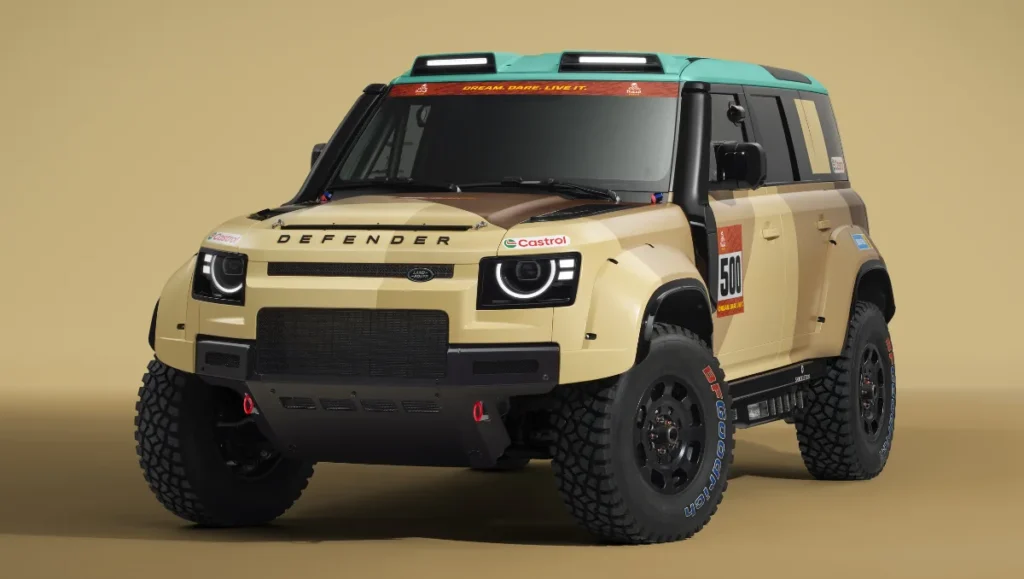
Land Rover Unveiled Dakar Rally Defender to the world, it felt like one of those moments where a long running rumour finally turns into metal, sand and noise. The brand has hinted for a while that Defender would not just support the Dakar Rally from the sidelines, but actually fight for stages. Now that Land Rover Unveiled Dakar Rally Defender D7X R as a full works entry built for the 2026 event, we can finally see how serious the company is about rally raid.
The move is about more than marketing photos in the dunes. With this project Land Rover steps into the same harsh arena where purpose built Dakar legends are born or broken. It is a statement that the modern Defender, especially in its wild Octa based form, is not just a luxury lifestyle 4×4 but a platform that can handle thousands of kilometres of rocks, dunes and brutal liaison sections.
Land Rover Unveiled Dakar Rally Defender Explained
The heart of the story behind Land Rover Unveiled Dakar Rally Defender is the new competition car called Defender Dakar D7X R. Under the skin it starts life on the same production line in Nitra, Slovakia, as the standard Defender, before it is handed over to the Defender Rally team in the United Kingdom for its transformation into a Stock category rally raid machine. That Stock label is important, because the rules demand a close connection to the road going model rather than a pure prototype.
Power still comes from the familiar 4.4 liter twin turbo V8 that already sits in the top Defender Octa models. In road trim that engine produces well over 600 horsepower, and in rally spec it stays surprisingly close to standard, with changes focused more on cooling, mapping and endurance than on headline power numbers. The transmission and driveline remain largely untouched as well, in line with the Stock regulations, although the gearing is adjusted for stronger low end response in the dunes and rocky climbs.
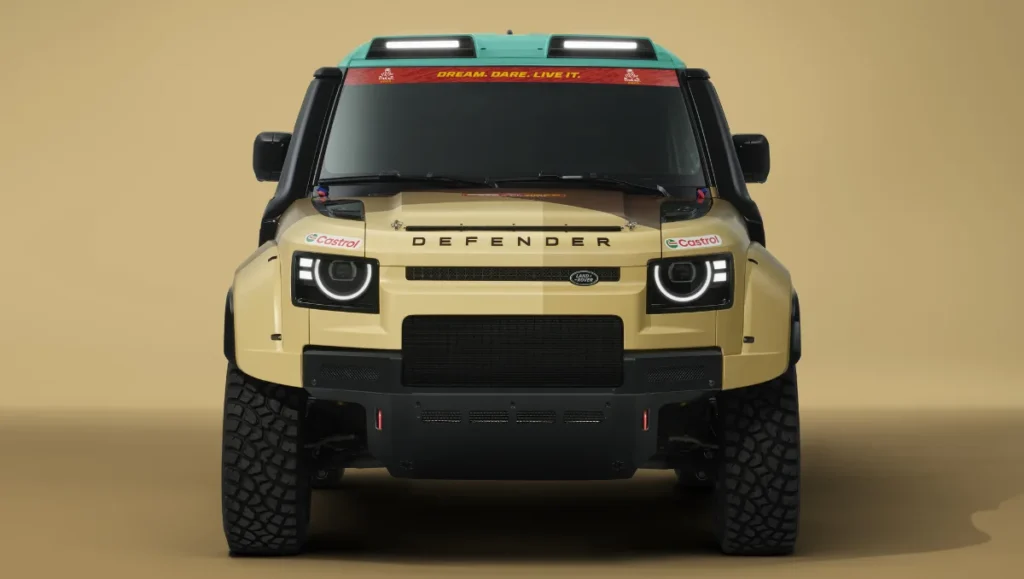
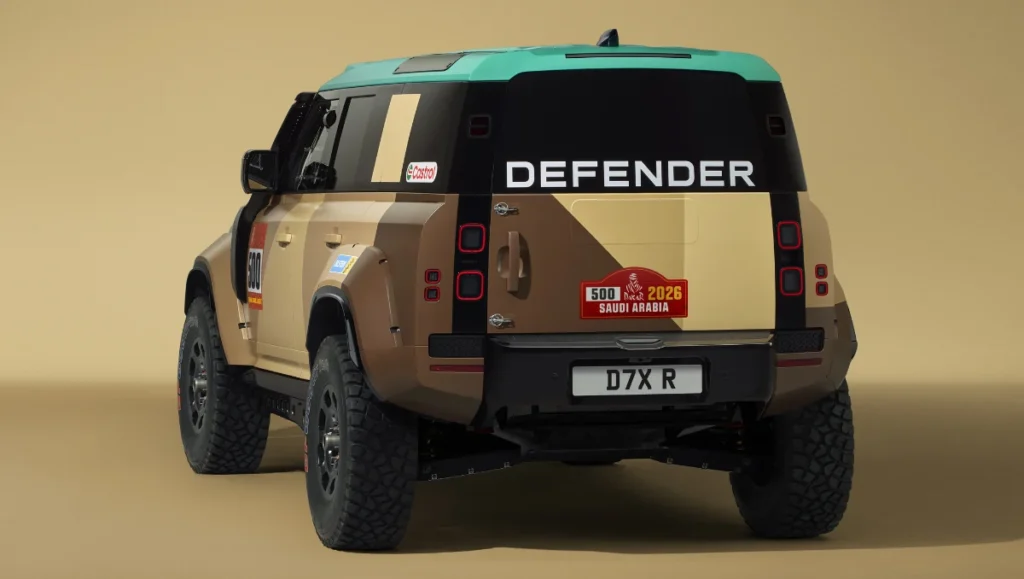
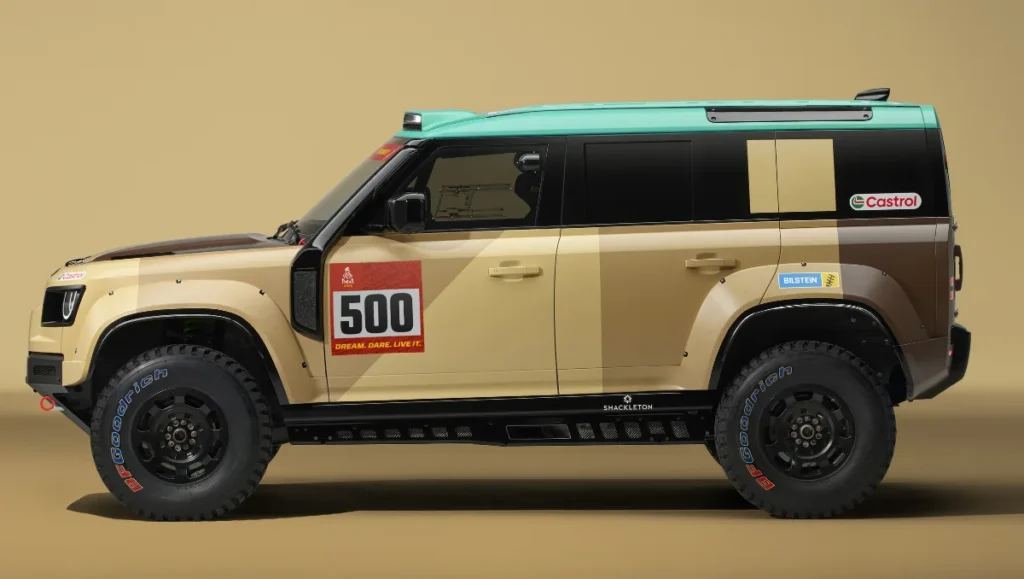
From the outside the rally Defender looks like a tougher, leaner cousin of the showroom car. The body is widened, the stance is taller and the lights, vents and aero details all hint at days spent at full throttle in deep sand. Yet the silhouette is still recognisably Defender, which is exactly what Land Rover wants when fans see Land Rover Unveiled Dakar Rally Defender attacking a stage on television.
Chassis, Flight Mode and Desert Hardware
One of the most striking details about the D7X R is just how much effort has gone into making it live comfortably in the desert for hours at a time. Land Rover engineers worked with specialists such as Bilstein on adaptive dampers, including twin rear dampers to handle the extra weight and forces from huge jumps and deep compressions. The suspension travel is generous, the underbody is heavily protected, and 35 inch off road tyres sit on rally grade wheels to deal with sharp rocks and soft sand.
Fuel is a big story too. Instead of the regular tank, Land Rover Unveiled Dakar Rally Defender with a massive rally spec fuel system. Reports talk about a capacity in the region of 145 gallons or around 550 litres, which is vital when stages can stretch for hundreds of kilometres with no chance to refuel. That extra fuel explains why so much work has gone into the rear suspension and weight distribution.
Then there is Flight Mode, a feature that has grabbed a lot of headlines. This clever software setting is designed for those inevitable moments when the car leaves the ground over big dunes or crests. Flight Mode manages torque delivery, suspension behaviour and driveline strain while the Defender is airborne and during landing, to protect components and keep the car stable for the next section. It is a neat modern twist that fits the whole character of Land Rover Unveiled Dakar Rally Defender as a blend of classic rally toughness and smart electronics.
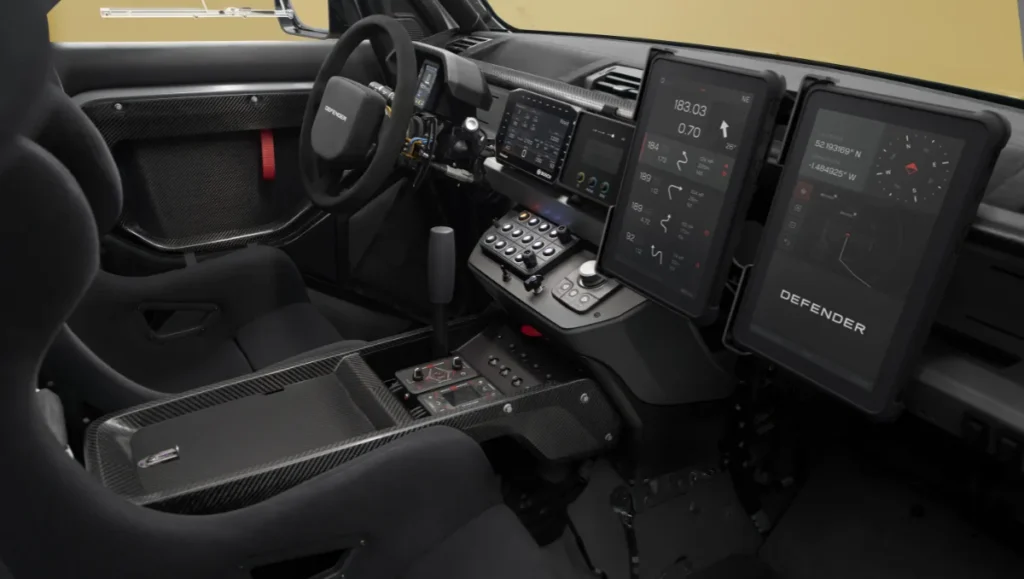
Inside, the transformation from luxury 4×4 to race car is total. The comfortable seats and large infotainment screens are gone, replaced by a full FIA approved roll cage, carbon fibre panels, deep bucket seats with multi point harnesses and a compact set of displays focused on navigation, temperatures and vital signs of the car. The rear seats are removed entirely to make space for three full size spare wheels, on board tools, hydraulic jacks, air systems and water storage. Everything is there for a reason, nothing more.
The Team behind the Land Rover Dakar Rally DefenderProject
Hardware alone will not win a Dakar Rally, and Land Rover knows it. That is why the brand has committed to a long term partnership with the event, running from the middle of this decade through to 2028, combining official vehicles for the organisation and a full works rally program starting with the 2026 edition.
To drive the D7X R, Defender has called in some very serious talent. The headline name is Stephane Peterhansel, the man many fans simply call Mister Dakar thanks to his record 14 overall victories in the event across bikes and cars. He returns to the rally with Defender after sitting out the previous edition, bringing decades of experience in reading the desert and protecting machinery over extremely long stages.
Alongside Peterhansel, the Land Rover Dakar Rally Defender line up includes young Lithuanian star Rokas Baciuska and American off road racer Sara Price, giving the team a mix of proven legends and hungry new generation talent. The project is run under the leadership of Ian James, heading the JLR motorsport effort, and the cars will compete not just at Dakar but across the wider World Rally Raid Championship calendar.
Testing has already taken place in Saharan style conditions, including in the Merzouga desert, where engineers and drivers have worked through suspension setups, cooling strategies and navigation systems in punishing heat. By the time Land Rover Unveiled Dakar Rally Defender appears on the 2026 start ramp, it will already have thousands of test kilometres behind it, which is essential for both speed and reliability.
Rivals, Category and What It Means for Fans
The Defender will run in the Stock category for production based vehicles, where it will face rivals like the Toyota Land Cruiser GR Sport and Nissan Patrol entries. On paper this might sound less extreme than the top prototype class, but in reality the pace is still fierce, and the connection to showroom models is actually closer in this part of the field. For Land Rover that is perfect, because every time fans see Land Rover Unveiled Dakar Rally Defender hammering across the desert, they are meant to think about the Defender they could actually buy.
In a way, this car closes a loop. Defender was born as a no nonsense tool for tough environments, and even though the modern version is more refined and tech heavy, the Dakar program proves that the core idea is still there. It also shows how far the brand has come in terms of engineering depth. You do not build a car with Flight Mode, a 145 gallon fuel tank and the ability to survive two weeks of flat out abuse unless you are serious.
For Dakar followers, a fresh factory team backed by such a famous name always brings extra excitement. It adds energy to the rally, pulls in new audiences and, if the battles stay tight, gives everyone another storyline to track. And for loyal Defender fans, watching the Land Rover Unveiled Dakar Rally Defender go wheel to wheel with long established teams will feel special, especially if it starts pushing toward podium spots early on.
Looking ahead to Dakar 2026 and beyond
The 2026 Dakar Rally is scheduled to cover more than 5,000 kilometres of timed stages over roughly two weeks, with total competitive driving time that can exceed 80 hours. In that environment, outright speed is only one part of the equation. Endurance, navigation, mechanical sympathy and team coordination matter just as much. That is why so much effort has gone into development before Land Rover Unveiled Dakar Rally Defender even reaches the start line.
If the project succeeds, it will do more than add a trophy or two to the cabinet. A strong Dakar run can influence how people see the whole Defender range, especially the high performance Octa models that share their core structure and powertrain with the D7X R. It can also push future updates in areas like cooling, durability, software control and suspension tuning, with lessons from the dunes making their way back to road cars over time.
Right now, though, the focus is simple. Finish building, keep testing and arrive in Saudi Arabia ready. When the flag drops on that first stage and Land Rover Unveiled Dakar Rally Defender launches into the dust, we will finally see how this bold idea performs in the real world. For a lot of enthusiasts, that moment cannot come soon enough.
Faqs – Land Rover Unveiled Dakar Rally Defender D7X R
1: What does Land Rover Unveiled Dakar Rally Defender actually refer to?
It refers to the official reveal of the Defender Dakar D7X R, a factory built rally raid version of the Defender that Land Rover has prepared specifically for the 2026 Dakar Rally.
2: What engine does the Dakar Defender use?
The rally version uses a 4.4 liter twin turbo V8 engine based on the Defender Octa, tuned for reliability, cooling and long distance endurance rather than just peak power.
3: Is the Dakar Defender based on the road car?
Yes, it is built from a production Defender shell that is later transformed into a race car, as required by the Stock category rules.
4: What makes the Dakar Defender different from the normal Defender?
It has stronger suspension, reinforced underbody protection, rally grade wheels and tyres, a huge fuel tank, special software like Flight Mode and a full racing interior with safety equipment.
5: What is Flight Mode on the Dakar Defender?
Flight Mode is a special system that helps manage the suspension and torque delivery when the vehicle goes airborne, helping protect mechanical parts and keeping the car stable when it lands.
6: Who is driving the Land Rover Unveiled Dakar Rally Defender?
The lineup includes legendary racer Stephane Peterhansel, rising Lithuanian driver Rokas Baciuska and American off road competitor Sara Price.
7: Which category will the Land Rover Dakar Rally Defender compete in?
It will run in the Stock class, a category designed for production based vehicles that still share much of their structure with the models found in showrooms.
8: Which cars will the Defender compete against at Dakar?
It will compete in the production based Stock category against vehicles such as the Toyota Land Cruiser GR Sport and Nissan Patrol rally entries.
9: What is Flight Mode on the Land Rover Unveiled Dakar Rally Defender?
Flight Mode is a software feature that manages torque, driveline load and suspension behaviour when the car is airborne over dunes or crests, helping it land smoothly and protect components.
10: Why is Land Rover entering the Dakar Rally now?
Land Rover has committed to a multi year partnership with the Dakar Rally and sees the event as the perfect stage to prove the capability of the modern Defender, especially the Octa based models that share engineering roots with the D7X R.
—