Maruti Celerio Gets 3-Star Rating in Global NCAP Here’s Why Buyers Are Paying Attention
Maruti Celerio Gets 3-Star Rating in Global NCAP has caught attention around a car long common in India. Safety was not the Celerio’s headline feature, which makes this outcome notable. The score reflects recent safety upgrades instead of a full redesign. It shows improvement over earlier models, but also highlights remaining limits. For buyers looking at budget hatchbacks, the rating sits in the middle. It suggests progress, though safety discussions remain active.
Why This Crash Test Matters Now
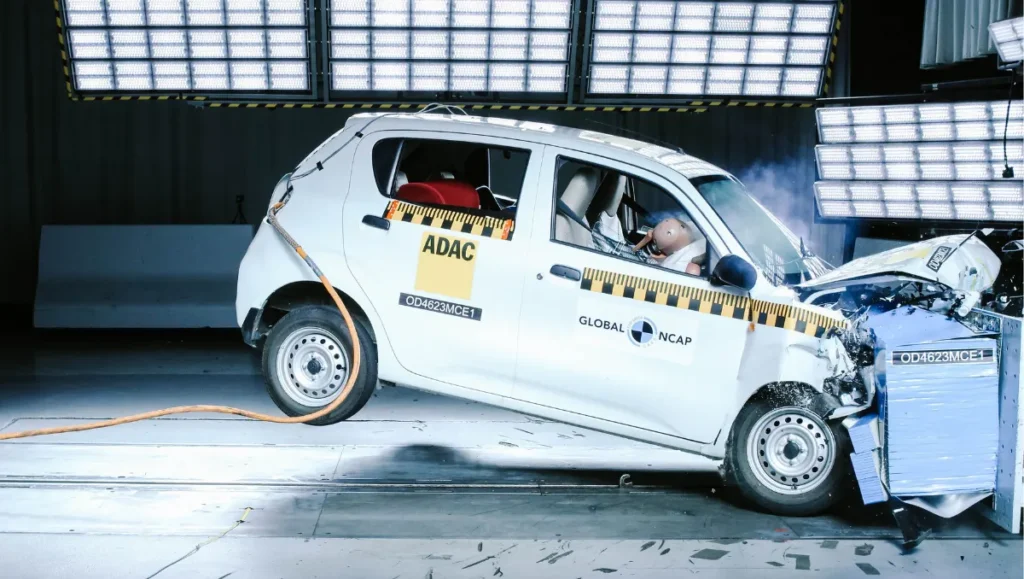
Global NCAP’s current test protocols are stricter than before, and cars that once scraped through with minimal safety equipment are now being reassessed under tougher conditions. The Celerio tested here is the India-spec version fitted with six airbags and electronic stability control. That point matters, since earlier versions running fewer airbags had already delivered weaker outcomes during previous rounds of testing
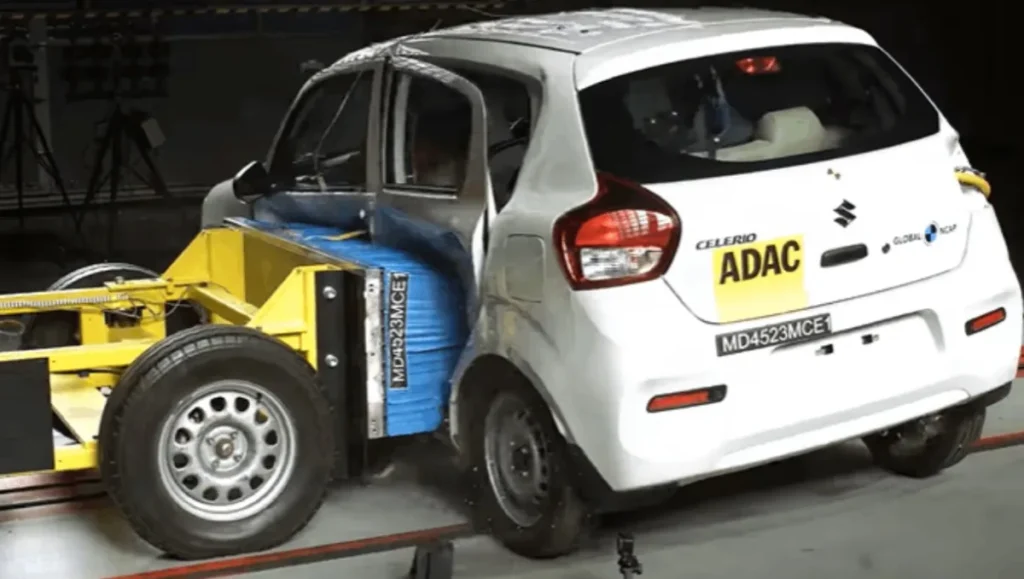
Maruti Celerio Gets 3-Star Rating in Global NCAP
Maruti Celerio Gets 3-Star Rating in Global NCAP after scoring 18.04 points out of 34 for adult occupant protection. The result just clears the three-star mark, without leaving much space past it. The result reflects a car that has improved through added safety equipment, yet still struggles with its underlying structure. It is a balanced score in the literal sense, not an impressive one.
Adult Occupant Protection Overview
In the frontal offset crash test, the Celerio performed reasonably for head and neck protection. Airbags deployed as expected and reduced direct impact forces on the driver and front passenger. However, chest protection for the driver was rated as weak, which immediately pulled the overall score down. Knee protection was marked as marginal due to the risk of contact with hard structures behind the dashboard.
Details from the Frontal Crash
Looking closer at the frontal crash data, the protection pattern feels uneven. Some areas show acceptable results, while others clearly do not. Head protection is doing most of the work here, largely because of the airbag coverage. But chest readings tell a different story, especially for the driver. These variations explain why the score settles into the middle rather than climbing higher.
Side Impact Performance
Side impact testing produced similar mixed results. Head and chest protection were rated as marginal, while abdomen and pelvis protection fared better. This inconsistency across body regions is another reason the car could not move beyond a three-star rating. Global NCAP’s assessment makes it clear that the safety performance is not uniformly strong across all impact types.
Structural Stability and Its Limits
One of the most significant comments in the report concerns the bodyshell. Global NCAP described the Celerio’s bodyshell as unstable and not capable of withstanding higher loads. This matters more than it might sound. Even with multiple airbags, an unstable structure limits how much protection a car can offer in more severe crashes. This single factor caps the overall safety potential.
Child Occupant Protection Score
Child occupant protection is still not a strong showing for the Celerio. The car recorded 18.57 points out of 49, leading to a two-star outcome. In frontal impact testing, both forward-facing and rearward-facing child restraint systems showed more head movement than expected. That movement directly affects injury risk and plays a major role in reducing the score.
Child Seat Behavior in Crashes
The data shows that while child seats could be installed, their performance during simulated crashes was not strong enough. Head excursion values exceeded ideal limits, particularly in frontal impacts. This does not mean children face danger in everyday use, though it clearly shows protection falls behind what higher-rated vehicles manage to deliver in formal test conditions.
ISOFIX Anchors and Expectations
The presence of ISOFIX anchor points is a positive and now expected feature. However, Global NCAP’s findings make it clear that ISOFIX alone does not guarantee high child protection. The interaction between child seats, restraint systems, and vehicle structure ultimately determines the outcome. In this case, that interaction was only moderately effective.
Safety Equipment That Made a Difference
Maruti Celerio Gets 3-Star Rating in Global NCAP mostly comes from safety gear fitted. Six airbags, electronic stability control, ABS with EBD, seatbelt pretensioners and load limiters helped shape adult protection score overall today here. These features are now doing measurable work in crash scenarios, even if they cannot fully overcome structural limitations.
Comparison with Older Celerio Results
Older Global NCAP evaluations of the Celerio running fewer airbags recorded lower safety scores, including only two stars for adults. The latest score shows clear improvement over those results. At the same time, it highlights a ceiling. Adding equipment improves outcomes, but without a stronger platform, gains remain limited.
What This Rating Really Tells Buyers
For buyers, Maruti Celerio Gets 3-Star Rating in Global NCAP signals moderate safety for adults in tested conditions. It suggests progress compared to older versions but does not place the car among the safest options available. For city driving at lower speeds, the safety package offers more reassurance than before. For long highway use or family-focused buyers, the numbers deserve careful reading.
Where the Gaps Still Exist
There are no advanced driver assistance systems offered here. Autonomous emergency braking and lane support features are missing here. These systems increasingly affect safety scores, mainly by reducing the chances of crashes happening. Their absence limits how far the Celerio can go under current testing standards.
How This Fits Into the Bigger Picture
Maruti Celerio Gets 3-Star Rating in Global NCAP points to a larger change within India’s auto space. Budget hatchbacks are under closer scrutiny now, and safety updates are slowly appearing in crash data. At the same time, the separation between entry cars and top performers remains obvious, especially when looking at body strength and child protection levels.
Closing Observation
Maruti Celerio Gets 3-Star Rating in Global NCAP feels balanced, neither impressive nor disappointing enough. It shows slow progress, bounded by older design thinking from before. The car is safer than it used to be, yet still far from leading the segment. The rating leaves room for improvement and keeps the safety conversation open rather than closing it.
FAQs – Maruti Celerio Gets 3-Star Rating in Global NCAP
FAQ 1: What Global NCAP rating did the Maruti Celerio receive?
The Maruti Celerio received a three-star rating for adult occupant protection under the latest Global NCAP crash test protocols.
FAQ 2: What score did the Celerio achieve for adult occupant protection?
The car scored 18.04 points out of 34 in adult occupant protection, which was enough to qualify for a three-star rating.
FAQ 3: Was the tested Celerio an India-spec model?
Yes, the tested vehicle was the India-spec Maruti Celerio fitted with six airbags and electronic stability control.
FAQ 4: How did the Celerio perform in frontal crash testing?
In frontal crash tests, head and neck protection were acceptable, but chest protection for the driver was rated as weak, affecting the overall score.
FAQ 5: What did Global NCAP say about the car’s structure?
Global NCAP stated that the Celerio’s bodyshell was unstable and not capable of withstanding higher loads during more severe impacts.
FAQ 6: What was the child occupant protection rating for the Celerio?
The Celerio received a two-star rating for child occupant protection, scoring 18.57 points out of 49.
FAQ 7: Why was the child safety score lower?
During frontal impact testing, both forward-facing and rearward-facing child restraint systems showed higher head movement than recommended.
FAQ 8: Does the Celerio come with ISOFIX child seat mounts?
Yes, the car is equipped with ISOFIX anchor points, though ISOFIX alone did not lead to a higher child safety score.
FAQ 9: Are advanced safety systems like AEB available on the Celerio?
No, features such as autonomous emergency braking and lane support are not offered, which limits the car’s ability to score higher.
FAQ 10: What does this rating mean for buyers?
The rating suggests moderate adult safety and some improvement over older versions, but it does not place the Celerio among the safest hatchbacks available.
—