Maruti Leads CY2025 as Mahindra Beats Tata and Hyundai in CY2025 Rankings
Maruti Leads CY2025 as Mahindra Beats Tata and Hyundai sounds simple, but the year was not. Maruti remained firmly ahead, and that part never shifted. What changed was below it. The second-place battle tightened and stayed that way. CY2025 brought healthy growth, a heavier pull toward SUVs, and clear changes in buyer behaviour across brands. Money moved differently. The numbers point to dominance at the top, disruption through the middle, and margins getting squeezed for players used to stable positions.

India wrapped CY2025 with about 4.55 million passenger vehicle wholesales, another record year by count. Growth eased after the pandemic rebound, demand stayed around in urban and semi-urban markets. SUVs crossed halfway once more. Buyers stayed there. They did not turn back.
Short Overview of CY2025
CY2025 was defined by scale, supply discipline, and segment focus. Brands that could deliver consistent volumes without heavy discounting did better than those chasing short-term spikes. The market added roughly 6 percent year on year, though progress was uneven in different parts overall.
SUVs accounted for close to 55.8 percent of passenger vehicle sales, higher than about 53.8 percent previously last year. That move alone shows why some manufacturers climbed beyond their usual weight, while others found themselves focused mainly on holding positions built over time.
Maruti at the Top
Maruti Suzuki ended CY2025 about where most analysts had pencilled it, right at the top. Passenger vehicle wholesales reached roughly 1.844 million units across the year, marking the company’s strongest domestic annual total yet to date ever. That number alone placed Maruti far ahead of every other manufacturer in India.
What kept Maruti ahead was not a single blockbuster model, but breadth. Volume came from everywhere, not one corner. Entry hatchbacks, compact cars, compact SUVs, and mid-size utility vehicles each played a role. That balance helped smooth out demand shifts month after month. Exports added further stability beyond domestic wholesales.
Total sales including exports crossed 2.35 million units in CY2025. Export volumes close to 396,000 units helped factories avoid stop-start production through the year.
Maruti Leads CY2025 as Mahindra Beats Tata and Hyundai
This wording points to two separate truths playing out together. Maruti’s advantage came from scale and steady delivery. Mahindra’s climb was driven by speed, confidence, and command of key segments. Mahindra turned into the clear mover of CY2025.
Registrations across the year reached roughly 5.81 lakh units, a steep rise from the prior year’s base of about 4.90 lakh units. That jump alone pushed Mahindra ahead of Tata Motors and Hyundai in multiple annual rankings.
The change mattered because Mahindra had long sat below those brands in overall passenger vehicle volumes. CY2025 became the first year it challenged the established order using full-year consistency rather than brief, short-lived surges or spikes.
Mahindra’s SUV Advantage
Mahindra’s performance in CY2025 was powered almost entirely by SUVs. The company sold more than 625,000 SUVs during the calendar year, crossing the 600,000 mark for the first time. This represented an increase of over 97,000 units compared to CY2024.
The lift came from breadth, not a single standout model across segments the year. Scorpio, Thar, Bolero, XUV700, and the newer compact SUV offerings all contributed meaningfully. No single model carried disproportionate weight, which reduced risk from supply disruptions or demand softening in one price band.
This SUV-heavy mix aligned perfectly with the broader market shift. As SUVs continued gaining share across total demand, Mahindra was effectively carried by the strongest wave running through the industry.
Tata Motors in CY2025
Tata Motors did not turn in a weak year by normal standards. Passenger vehicle volumes reached roughly 587,218 units during CY2025, placing Tata among the country’s leading auto manufacturers nationally today.
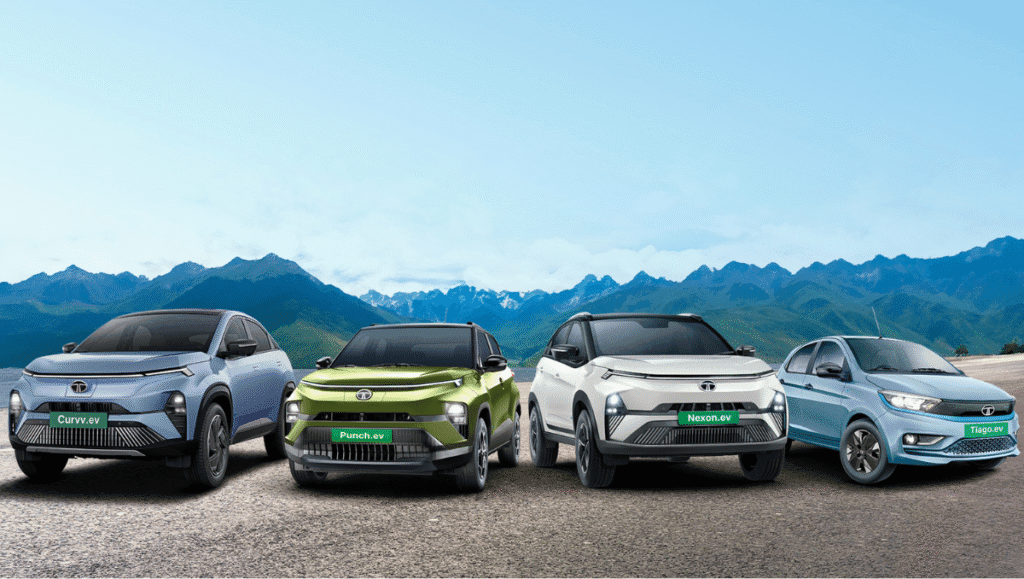
Electric vehicles remained a highlight. Tata delivered over 81,000 EVs during the year, its best calendar-year EV result, helping preserve leadership while competition slowly intensified across the electric passenger vehicle segment nationwide overall.
However, while Tata’s numbers were solid, growth was steadier rather than explosive. In a year where SUVs expanded rapidly and Mahindra accelerated faster, Tata found itself edged out in the race for second place in some rankings.
Hyundai’s Position
Hyundai’s CY2025 story was one of resilience under pressure. Annual volumes stood close to 550,000 units, keeping the brand tightly in the mix but slightly behind Tata in some counts and behind Mahindra in several registrations-based comparisons.
Hyundai continued to benefit from strong brand recall, stable service reach, and consistent performance from its core models. However, the pace of SUV expansion and intense competition in key segments limited how much it could stretch beyond its established base.
The gap between Tata and Hyundai was narrow, and small variations in reporting cutoffs or datasets could change the ordering. What remained clear was that both brands faced a new kind of pressure from Mahindra’s SUV-led surge.
Registrations versus wholesales
One reason the CY2025 rankings sparked debate is the difference between registrations and wholesales. Registrations reflect vehicles actually entering the system, while wholesales measure factory dispatches.
In a year with tight supply chains and careful inventory management, the two can diverge. Mahindra’s strength in registrations highlighted strong retail demand and delivery execution, while Tata and Hyundai’s wholesales showed stability but less acceleration.
Understanding this distinction helps explain why multiple rankings can coexist without contradiction.
SUV Dominance Reshaping the Market
SUVs climbing to nearly 56 percent of passenger vehicle sales in CY2025 changed how competition played out. Brands already deep into SUVs enjoyed pricing strength and longer waiting periods. Those with broader lineups had to work harder to hold margins. This does not feel cyclical.
Buyers now treat SUVs as normal family vehicles, not upgrades, a mindset shift that is shaping product planning decisions well beyond the near term.
Maruti’s Balancing Strength
Maruti’s continued dominance came from balance rather than specialization. Across December 2025 alone, domestic sales moved past 182,000 units, nearly 74,000 of which were utility vehicles.
Strong coverage across segments reduced Maruti’s vulnerability to sudden preference swings. While SUVs grew faster, compact cars still delivered meaningful base volume, ensuring Maruti’s lead remained unchallenged.
What CY2025 Really Showed
Maruti Leads CY2025 as Mahindra Beats Tata and Hyundai works because it reflects how the market now operates. Leadership is still about scale, but upward movement is about alignment with demand trends.
Mahindra’s CY2025 rise was earned over time. Consistent SUV investment, strong execution, and measured expansion across pricing drove results. Tata and Hyundai remained solid, but the middle order compressed more tightly as the season unfolded through late 2025.
Looking Ahead
With 2026 drawing closer, the industry faces uneasy doubts about how long growth survives. Can Mahindra maintain SUV momentum without stretching capacity. Can Tata translate EV leadership into faster overall growth. Can Hyundai regain lost ground with new launches.
Maruti, meanwhile, enters the next cycle from a position of strength, with scale, exports, and portfolio depth all working in its favor. CY2025 did not rewrite the rulebook, but it clearly showed that the hierarchy below the top is no longer fixed.
FAQs – Maruti Leads CY2025 as Mahindra Beats Tata and Hyundai
FAQ 1: What does “Maruti Leads CY2025 as Mahindra Beats Tata and Hyundai” actually mean?
It means Maruti remained the largest passenger vehicle maker in India during CY2025, while Mahindra moved ahead of Tata Motors and Hyundai in some rankings, especially when registrations and SUV-led growth are considered.
FAQ 2: How many passenger vehicles were sold in India during CY2025?
India recorded around 4.55 million passenger vehicle wholesales in CY2025, making it another record year for the market despite growth slowing from the earlier post-pandemic rebound phase.
FAQ 3: Why did Mahindra perform so strongly in CY2025?
Mahindra’s performance was driven largely by SUVs. The company crossed 625,000 SUV sales in a single calendar year for the first time, with demand spread across multiple models rather than depending on one bestseller.
FAQ 4: Did Maruti Suzuki lose market leadership in CY2025?
No. Maruti Suzuki remained firmly in first place. Domestic passenger vehicle wholesales stood at around 1.844 million units, keeping Maruti well ahead of every other manufacturer in overall volume terms.
FAQ 5: How important were SUVs to the overall market in CY2025?
SUVs accounted for nearly 55.8 percent of total passenger vehicle sales in CY2025, rising again from the previous year and confirming SUVs as the dominant segment for Indian buyers.
FAQ 6: Where did Tata Motors stand in CY2025?
Tata Motors had a stable year with passenger vehicle volumes of about 587,218 units. The company remained among India’s leading manufacturers, even though growth was steadier compared to Mahindra.
FAQ 7: What role did electric vehicles play in Tata’s performance?
Electric vehicles were a key strength for Tata Motors. The company delivered over 81,000 EVs during CY2025, helping it retain leadership in the electric passenger vehicle segment despite rising competition.
FAQ 8: Why did Hyundai slip in some CY2025 rankings?
Hyundai’s volumes stayed close to 550,000 units, but faster SUV-led growth from Mahindra pushed Hyundai behind in several registrations-based comparisons. The difference between Hyundai and Tata remained narrow.
FAQ 9: What is the difference between registrations and wholesales?
Registrations reflect vehicles that are actually registered for use, while wholesales track vehicles dispatched from factories to dealers. In CY2025, the gap between these two measures led to different brand rankings.
FAQ 10: What is the main takeaway from CY2025 for the auto industry?
CY2025 showed that while scale still defines the market leader, growth momentum now depends heavily on SUVs and product mix. Positions below the top are no longer fixed and can change with sustained execution.
—