Maruti Victoris Bio Gas Unveiled at 2025 Japan Mobility Show – Maruti’s Green Leap Forward
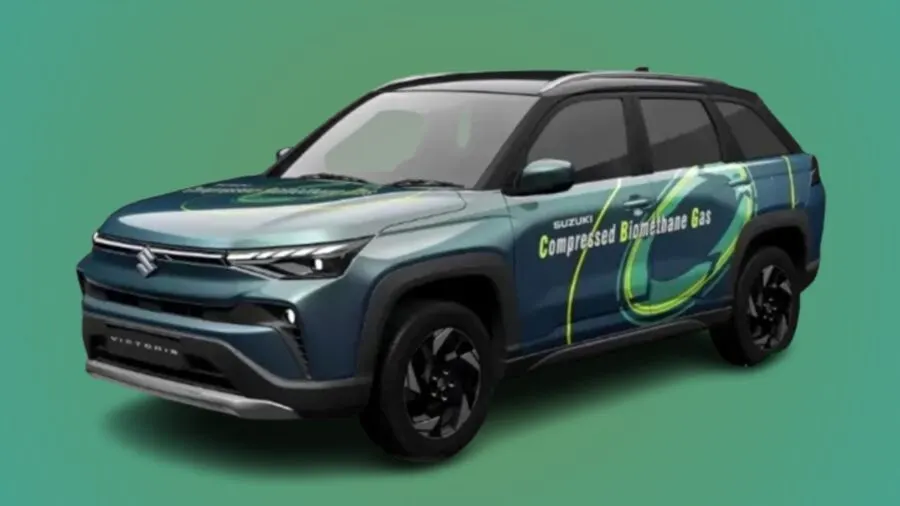
The Maruti Victoris Bio Gas SUV has officially made its global debut at the 2025 Japan Mobility Show, signaling a major shift in Maruti Suzuki’s commitment to sustainable mobility. This new Compressed Bio Gas (CBG) variant is a prototype built on the existing CNG version of the Victoris, but with a renewable fuel twist. Built to combine practicality, efficiency, and environmental sustainability, the Maruti Victoris Bio Gas is evidence of the company’s visionary edge when it comes to green technology and cleaner mobility.
What is the Maruti Victoris Bio Gas SUV
The Maruti Victoris Bio Gas is a Compressed Bio Gas-powered compact SUV concept vehicle that is environmentally friendly compared to conventional fossil fuels. Extracted from biological waste such as crop residues, municipal solid wastes, and animal dung, bio gas provides a renewable, carbon-neutral source of power. In contrast to CNG, which relies on fossil fuel extraction, bio gas is completely sustainable and also helps reduce waste and create employment in rural areas.
Maruti Suzuki has already made Victoris available in petrol, CNG, and hybrid options. This new Bio Gas variant offers a fourth, green alternative that underscores the company’s growing emphasis on clean fuel technologies.
Engine, Powertrain, and Technology
Below the bonnet, the Maruti Victoris Bio Gas (CBG) uses the company’s tried-and-tested 1.5-litre, 4-cylinder petrol engine, which has been specially developed for smooth bio gas combustion. The engine gives performance similar to the CNG variant, which should churn out an estimated 161 bhp and 246 Nm of torque, with a 6-speed manual or automatic transmission system.
The CBG system employs a two-cylinder tank configuration placed under the floor, leaving boot space relatively unchanged — an intelligent packaging solution already tested in the CNG Victoris.
Bio Gas, as opposed to traditional CNG, is obtained from organic and renewable sources, providing a cleaner burn and much lower carbon emissions. This not only helps improve fuel efficiency but also cuts down particulate pollution, making it one of the most viable green fuels for India’s city and semi-rural scenarios.
Sustainability and Environmental Benefits
The Maruti Victoris Bio Gas SUV is not just an engineering display — it’s a dream of what cars can do for the environment. With renewable Compressed Bio Gas, Maruti Suzuki hopes to:
- Cut green house gas emissions
- Lessen crop residue burning
- Help improve waste management programs
- Create rural jobs through bio gas manufacturing plants
This aligns perfectly with India’s push for alternative fuels under the National Bio Fuel Policy, which encourages automakers to explore cleaner, indigenous energy sources.
Maruti’s choice to unveil the Victoris Bio Gas variant on an international stage like the 2025 Japan Mobility Show underscores its confidence in Indian-developed technology that has global potential.
Design and Features
Exterior-wise, the Maruti Victoris Bio Gas SUV is much like the petrol and CNG variants, still having the brand’s contemporary design language — a striking grille, muscular lines, and LED lighting features. The CBG prototype could, however, be distinguished by green-accented detailing and subtle badges.
Within, the cabin prioritizes robustness and technology. The SUV receives a 12.5-inch infotainment unit, an all-digital instrument cluster, and Toyota-sourced Safety Sense features such as adaptive cruise control, lane-keeping assistance, and automatic emergency braking.
The Victoris Bio Gas provides an ideal balance between daily practicality and eco-friendliness, appealing to customers who appreciate performance and sustainability.
Why Bio Gas Makes Sense for India
The Maruti Victoris Bio Gas idea may prove to be a game-changer for India’s fuel economy. Since the nation generates more than 600 million tonnes of agricultural and organic waste every year, CBG has tremendous potential as a native, sustainable energy source.
Every Victoris CBG vehicle had the potential to indirectly benefit farmers by minimizing the use of stubble burning and encouraging nearby energy production initiatives. Also, unlike electric cars, CBG-fueled vehicles don’t depend on importing lithium or mass-scale charging installations, presenting an instant and scalable green mobility answer.
Launch Timeline and Market Plans
Maruti Suzuki has confirmed that Victoris Bio Gas SUV will make its debut as a prototype in 2025 Japan Mobility Show. Though no India launch is officially confirmed, the increasing domestic emphasis on cleaner fuels makes it very likely that it will enter the market in the next few years.
If it reaches Indian showrooms, the Maruti Victoris Bio Gas could position itself between the CNG and hybrid variants, appealing to customers looking for an eco-friendly yet practical alternative to electric vehicles.
Given Maruti’s massive dealer network and strong sales volume, the CBG model could play a significant role in mainstreaming renewable fuels for mass-market SUVs.
Price Expectations and Rivals
The existing Maruti Victoris lineup ranges from ₹10.50 lakh to ₹19.99 lakh (ex-showroom). The Bio Gas model is likely to be priced slightly more than the CNG model but less than the hybrid model.
It will face competition from the likes of the Hyundai Creta, Kia Seltos, Honda Elevate, MG Astor, and Volkswagen Taigun — but with a very special advantage: its renewable fuel technology.
This green-minded positioning would make Victoris Bio Gas India’s most affordable green SUV, providing environmentally friendly mobility at an affordable price without the expense of hybrid or EV technology.
Conclusion: A Step Toward Cleaner Driving
The Maruti Victoris Bio Gas model is a milestone in the path of Maruti Suzuki to cleaner and greener mobility. It merges the company’s established reliability with pioneering renewable technology, marking a transition from efficiency to full-scale sustainability.
As India progresses toward a renewable-fuel-driven future, the Victoris Bio Gas SUV might prove to be one of the most functional and environmentally friendly cars on the planet. It’s not another variant – it’s a declaration that sustainable transportation has to be affordable, functional, and of Indian origin.
FAQs – Maruti Victoris Bio Gas SUV
1. What is Maruti Victoris Bio Gas SUV?
It’s a Compressed Bio Gas (CBG) powered prototype SUV, which was showcased by Maruti Suzuki at the 2025 Japan Mobility Show.
2. How does the Victoris Bio Gas differ from the CNG variant?
The Bio Gas variant is fueled by renewable CBG rather than fossil-based CNG, thus it is more sustainable and environmentally friendly.
3. What is the engine in the Maruti Victoris Bio Gas?
It gets a 1.5-litre, 4-cylinder petrol motor tuned for effective CBG combustion.
4. What power and torque levels are expected?
It is expected to produce about 161 bhp and 246 Nm of torque.
5. Does the Victoris Bio Gas share the same design with the other variants?
Yes, it is the same design as the petrol and CNG versions but could feature green trim and CBG badging.
6. What are the key advantages of using Bio Gas fuel?
Bio Gas cuts emissions, avoids crop burning, promotes waste management, and creates rural employment.
7. Will the Maruti Victoris Bio Gas be launched in India?
Although unconfirmed, a launch in India is extremely likely due to the emphasis on green fuel technology.
8. How much will the Maruti Victoris Bio Gas be priced?
It’s going to be marginally higher than the CNG model but lower than the hybrid variant.
9. Against which SUVs will the Victoris Bio Gas rival?
It will compete with the Hyundai Creta, Kia Seltos, Honda Elevate, MG Astor, and Volkswagen Taigun.
10. Why is the Victoris Bio Gas significant for Maruti Suzuki?
It showcases Maruti’s shift toward sustainable mobility and innovation in renewable fuel technology.
—