Tata Launches Fleet-Only XPres Petrol And CNG Variants: New Taxi King Starts at ₹5.59 Lakh!
We’ve all dealt with the “CNG trunk” nightmare at some point. You bring a couple of bags to the curb, and the driver just points to the roof because his trunk is 90% gas cylinder. It’s either pay for a second cab or sit like a sardine with a suitcase pressing against your chest the whole way. However, that specific headache might finally be on its way out. In a massive play for the commercial market, Tata Launches Fleet-Only XPres Petrol and CNG Variants, and they seem to have actually listened to what drivers and passengers have been complaining about for years.

Originally, the XPres brand was the “EV-only” child of the family. It was clean, quiet, and great for city loops, but not every fleet operator is ready to go full electric just yet. By rolling out internal combustion engine (ICE) versions of the XPres, the manufacturer is essentially giving the people what they want: a familiar platform that doesn’t require a charging cable.
Why the Shift Back to Petrol and Gas?
It’s easy to wonder why a company would go “backward” from EV to petrol. The reality on the ground is that India is a massive, diverse landscape. While Mumbai or Delhi might have plenty of chargers, a driver taking a fare from a metro area to a rural village needs the security of a fuel pump. By ensuring that Tata Launches Fleet-Only XPres Petrol and CNG Variants now, they are capturing the middle ground—the operators who want the reliability of a subcompact sedan without the “range anxiety” of a battery.
This isn’t just a Tigor with a different badge. The XPres is stripped of the “fluff” that private buyers want but taxi owners don’t want to pay for. It’s a tool. It’s built for 15-hour shifts, dusty roads, and a constant rotation of passengers.
The Engineering Magic: Twin Cylinders
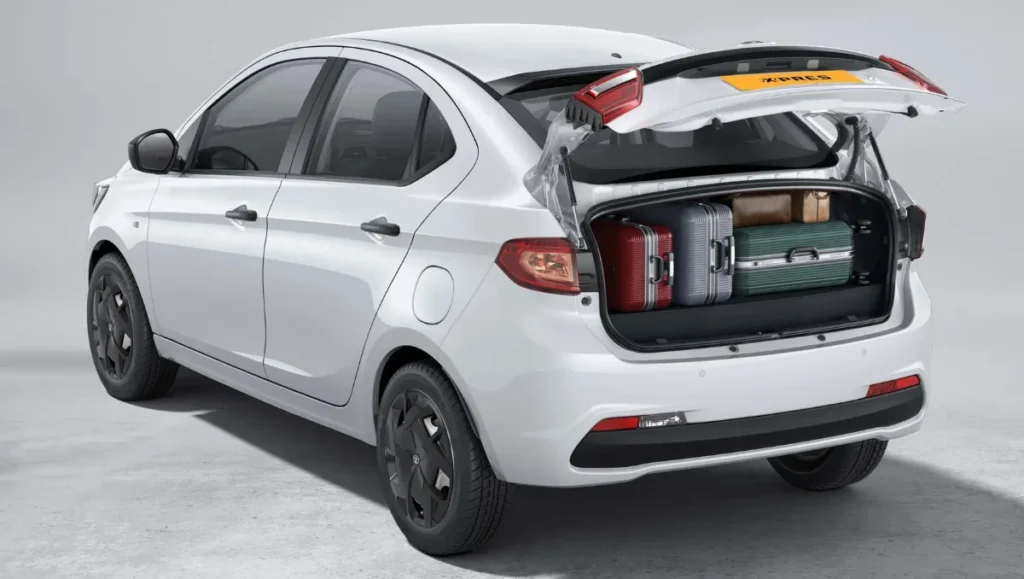
The real “star of the show” here isn’t the engine—it’s the trunk. Normally, picking a CNG car means saying goodbye to your trunk. But with this new version, they’ve used their clever twin-cylinder setup to actually save some room for your bags. Instead of one giant, bulky tank, they’ve tucked two smaller cylinders under the floorboards.
When Tata Launches Fleet-Only XPres Petrol and CNG Variants, they aren’t just selling a car; they are selling 227 litres of usable boot space in a gas-powered vehicle. For a tourist taxi, that’s the difference between getting a fare to the airport or watching that passenger wave down a larger, more expensive SUV. The petrol version is even more cavernous, offering 419 litres, which is frankly massive for a car in this footprint.
Breaking Down the Performance
The oily bits consist of the 1.2-litre Revotron engine. It’s a basic three-cylinder unit that’s famous for being a workhorse in India. If you’ve driven a cab in the last few years, you’ve likely used this engine.
- The Petrol Experience: You’re looking at about 86 hp here. While it won’t thrill you on a highway sprint, it feels perfectly at home in tight city traffic where responsiveness at low speeds matters more than top-end speed.
- The CNG Experience: This is where the money is made. It’s slightly less powerful when running on gas, but the trade-off in fuel costs is huge. The transition between petrol and CNG is almost seamless now, thanks to a dedicated ECU that handles the switchover without the car shuddering like the old aftermarket kits used to do.
What’s clever is the “Direct Start” feature on the CNG model. Most older CNG cars forced you to start on petrol and then switch. Here, you can crank it up directly on CNG, saving those precious drops of expensive petrol every single time the driver turns the key.
Inside the “Mobile Office”
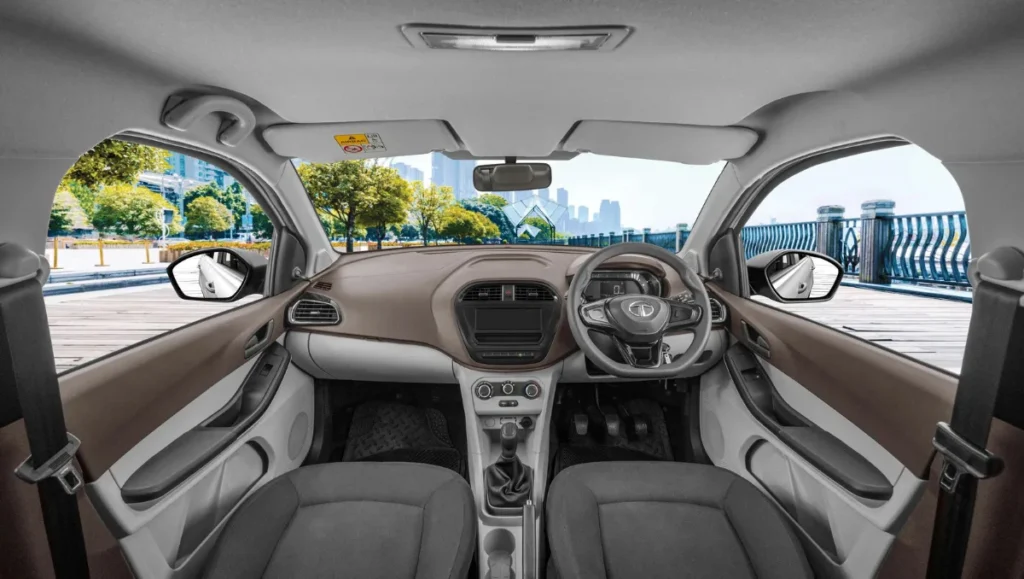
The company clearly knows that a car is a driver’s office, so they didn’t cut corners on the basics. You get tilt steering and a seat you can move up or down without paying extra—standard equipment that usually gets stripped out of base-level taxis. For a guy who’s 6 feet tall or someone quite short, it means they can finally find a driving position that won’t leave them aching by the end of the shift.
Stepping inside, the dual-tone finish is a nice upgrade over the usual “fleet-spec” grey plastic. The whole cabin is basically “wipe-clean” for convenience. You won’t find a trace of fancy carpeting; the manufacturer used durable floor and seat materials that can actually withstand a constant stream of messy footwear.
Safety: No More Cutting Corners
In the past, fleet cars were often de-specced to the point of being dangerous. That’s not the case here. When Tata Launches Fleet-Only XPres Petrol And CNG Variants, they are bringing along a 4-star safety DNA. You get dual airbags, ABS, and EBD right out of the gate.
There is also a significant focus on fire safety for the CNG model. It features a leak detection system and a fire extinguisher mounted under the seat. If the fuel lid is open, the car won’t even start—a simple but brilliant “idiot-proof” safety measure to prevent accidents at the gas station.
The Business Case: Profits per Kilometre
For the fleet owner, the math is simple.
- It starts at ₹59 lakh for the petrol. If you need the CNG tanks, you’re looking at a ₹6.59 lakh entry point.
- Maintenance: They are claiming a service cost of roughly 47 paise per kilometre.
- Warranty: 3 years or 1 lakh kilometres is the standard, which covers the typical “heavy use” period of a new taxi.
If a driver covers 200km a day, the savings on the CNG variant compared to a petrol hatchback are staggering. Over a year, that’s enough to cover the EMI of the car itself. That’s why these cars are likely to become the new “kings of the road” for ride-hailing apps.
Comparison: Petrol vs. CNG for Fleets
| Feature | XPres Petrol | XPres CNG |
| Ideal For | Intercity / Hill Stations | Intra-city / Airport Runs |
| Boot Capacity | 419 Litres | 227 Litres |
| Starting Price | ₹5.59 Lakh | ₹6.59 Lakh |
| Fuel Tank | 35 Litres Petrol | 70L (Water Capacity) |
Why Fleet Owners Are Finally Getting What They Asked For
This launch is a loud and clear message to the competition: the brand isn’t backing down from its lead in the commercial world. By rolling out a sedan that actually fits a passenger’s bags without sacrificing safety or professional looks, they’ve basically hit the bullseye.
The “fleet-only” badge is a smart move too. It keeps the resale value of the private Tigor higher while allowing the company to offer deeper discounts and specialized service packages to the big taxi aggregators. It’s a pragmatic, boots-on-the-ground solution for a country that is still finding its way through the energy transition.
FAQs – Tata Launches Fleet-Only XPres Petrol And CNG Variants
1: What is the price tag for these new models?
The petrol starts at ₹5.59 lakh, and you’ll need ₹6.59 lakh for the CNG version.
2: Can I actually put suitcases in the CNG trunk?
Yes, you get about 227 litres of space because the tanks are hidden under the floor.
3: Can a regular person buy this for their family?
No. This is a “fleet-only” deal meant for taxi owners and commercial companies.
4: How much will I spend on servicing every month?
They’re saying it costs about 47 paise per kilometre to keep it running.
5: Is the CNG car going to struggle on hills or in traffic?
It’s not a racer, but it has plenty of zip for city stop-and-go driving.
6: What safety gear is packed into a commercial car like this?
You get two airbags and ABS as standard, plus a 4-star safety rated structure.
7: What if the driver forgets to close the fuel cap?
The car just won’t start. It’s a simple safety lock to prevent gas station accidents.
8: Do I still have to warm up the engine on petrol?
Nope. You can crank it up directly on CNG and save your petrol money.
9: How long is the factory warranty for a taxi?
It’s covered for 3 years or 1 lakh kilometres, whichever hits first.
10: Why choose this over the electric XPres-T?
It’s better for long trips or rural areas where you can’t find a charger easily.
—