Tata Sierra Collision Crash Test – What You Should Know
When you hear Tata Sierra Collision Crash Test, it carries weight. On 25 November 2025, Tata Sierra made headlines across India because its manufacturer didn’t just crash it into a wall — they ran a full-on car-to-car crash test using two identical Sierras head-on. That one act changes a bit of how we might think about crash safety of Indian cars going forward.
Here’s a breakdown of what happened, what we know now, and what to keep in mind — all based on published and verifiable details.
What Exactly Happened in the Crash Test
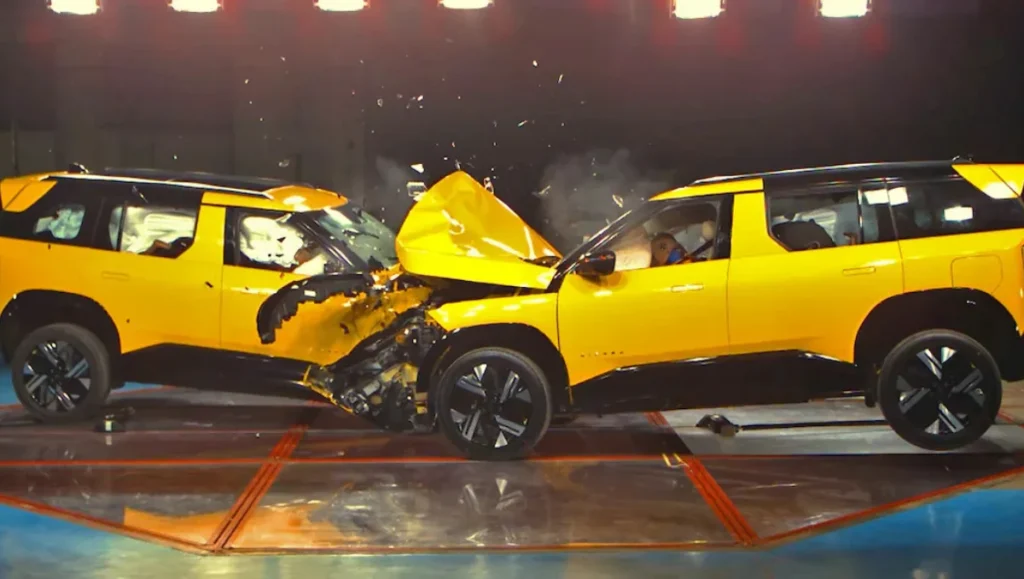
Late November 2025: during the launch of the new Sierra, Tata Motors showed a recorded crash demonstration. Two brand-new Sierra SUVs collided head-on at a controlled speed. According to reports, this is the first time an Indian automaker has shown a full-scale car-to-car head-on collision test to highlight structural safety, rather than relying only on crash-barrier or static crash tests.
After the crash, Tata released some of the immediate results:
- The passenger cell (cabin) remained intact in both cars.
- Doors reportedly opened after impact, meaning structural deformation was limited enough to allow exit.
- The fuel system stayed sealed, reducing risk of post-crash fire.
- Seat belts and restraint systems functioned as intended.
That does not mean zero damage — the front-ends of both vehicles absorbed the impact heavily, as expected. But the survival of the cabin and restraint of occupants (simulated via crash-test dummies) is the real takeaway.
What Safety Equipment Comes With The Sierra
Of course, good crash structure alone doesn’t guarantee safety — you also need good active and passive safety systems. Sierra, as per its feature sheet, comes well equipped. Here are some of the highlights cited by auto media.
- Six-airbag layout (driver, front passenger, side airbags, etc.) — base safety fitment rather than a premium-only add-on.
- Electronic Stability Program (ESP), Traction Control System (TCS) — stability aids that help avoid loss of control.
- Advanced Driver Assistance Systems (ADAS) suite — reportedly Level-2 with features like blind-spot detection, 360-degree surround camera / blind-view monitor for safer lane changes and parking.
- Modern safety-centric build philosophy — strong structural integrity, well-designed crumple zones, reinforced cabin cell — which likely helped during the crash test.
In short — the Sierra isn’t just built with a strong frame. It comes with modern safety aids that, when combined with robust structural design, offer a better shot at protecting occupants in real-world crashes.
Why A Car-to-Car Crash Test Matters More Than a Wall Crash
Traditionally, crash testing (especially in India) has involved crashing a vehicle into a fixed barrier or deformable wall. That gives a baseline, but real life accidents are rarely so clean. Many collisions happen between two moving vehicles, both with their own momentum and variables.
By crashing two identical cars head-on, Tata tried to simulate more realistic energy, collision dynamics, forces and damage patterns. It’s not perfect science (after all, many real-life crashes involve mis-matched vehicles, different speeds, angles, etc.) but as a demonstration, it gives a better gauge of how the safety cage and restraint system behave under severe duress.
Especially in a country like India, where road conditions, driving behaviour and mixed traffic make crashes unpredictable — this approach by a manufacturer is a meaningful step.
What We Still Don’t Know (Yet)
Important to remain realistic: despite the promising demonstration, many details are still not public or not verified yet.
- As of now, no formal crash-test rating from independent bodies like Bharat NCAP or Global NCAP has been released for Sierra. The internal crash demonstration doesn’t substitute for a full formal test.
- No publicly shared dummy-injury metrics (head/neck/chest acceleration), no intrusion measurements and no post-crash stability tests. What we have is qualitative: cell intact, doors open, fuel sealed. That’s good, but not conclusive for real-world safety across varied crash scenarios.
- Real-world crashes vary widely: speed, angle, whether occupants use seat belts, vehicle load, maintenance, and many other factors — the crash-test only simulates one scenario: a clean head-on collision between identical vehicles at controlled speed. It doesn’t guarantee similar result in every crash.
So, while promising, this demonstration must be seen as a positive early indicator, not a definitive safety guarantee.
What It Means for Indian Car Safety & Buyers
If you are evaluating the Tata Sierra for purchase — especially if safety is a big concern — the crash-test demonstration adds real value. Here’s what you get with Sierra:
- A modern safety-first design ethos from manufacturer: reinforced cabin cage, crumple-zone planning, crash-worthy build.
- Modern passive and active safety aids: airbags, ESP/TCS, ADAS, cameras, blind-spot monitors — features that help avoid or mitigate accidents, not just survive them.
- A manufacturer willing to show transparency: by crashing two cars and revealing what happened, Tata sets a precedent. That’s rare in India currently, and could push other automakers to raise their safety game too.
- Better peace of mind for families: if you travel often, or drive on rough roads, the combination of safety kit and proven structural strength means Sierra is among the safer choices in its price / segment bracket.
Still, I’d recommend waiting for an independent crash-test result when available. That will give objective scores, detailed measurements, and a clearer safety rating under standardized tests.
Final Thoughts
Tata Sierra Collision Crash Test — the phrase now stands for something more than marketing. On 25 November 2025, when Tata Motors showed two Sierras colliding head-on and surviving with structural integrity, it sent a message: in India, automakers too can prioritise real-world crash safety over just passing basic standards.
For buyers, it means a vehicle that doesn’t just have modern looks or creature comforts — but also a backbone built to protect. For the auto industry, it marks a potential shift: from plain barrier crash tests to more realistic collision simulations.
If you’re looking for a mid-size SUV with style plus a serious shot at safety, the Sierra just raised the bar. Keep your fingers crossed for the formal crash-test results — but also appreciate what’s already on the table.
Faqs – Tata Sierra Collision Crash Test
1: What is this Tata Sierra collision test people are talking about?
It’s basically a demo where Tata crashed two Sierra cars into each other to show how strong the car body is and how it protects people inside.
2: When did this crash thing actually happen?
It was shown around the last week of November 2025 when Tata was showing off the new Sierra.
3: Is this the same as those official NCAP crash tests?
No, not really. This was Tata’s own test, not done by official agencies like Bharat NCAP or Global NCAP.
4: Did the car completely break apart in the crash?
No, from what was shown, the passenger area stayed in shape and the doors could still be opened after the crash.
5: Are official safety star ratings available for this car?
No, there are no official star ratings out yet for the Sierra.
6: What kind of safety things does the Sierra have?
It has airbags, stability control, traction control and some high-tech driver help systems in higher models.
7: Why do people say car-to-car crash is more realistic?
Because in real life you usually hit another car, not a wall. So this test feels closer to real road accidents.
8: Does this test mean the car is totally safe in any crash?
No car can be 100% safe. Real crashes depend on speed, angle of impact and whether people wear seatbelts.
9: Is Sierra a good car if I care about family safety?
From what we’ve seen, it looks like Tata tried to make it strong and safe, but real official test results will give the full picture.
10: Should I wait before buying if safety matters to me?
If safety is very important for you, then yeah, it makes sense to wait for official crash test results before making a final decision.
—