Tesla Launches Model Y Standard in Europe with Precise Price Reductions
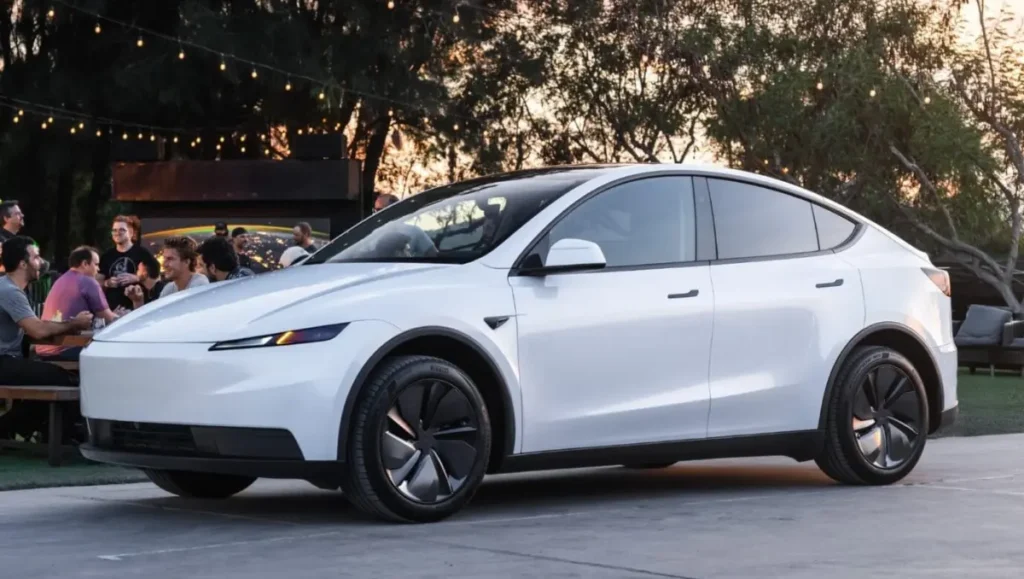
Tesla Model Y Standard variant has rolled out at lower-priced in Europe, releasing the Model Y Standard trim in several markets just weeks after introducing it in the United States. The action is designed to drive sales in Europe, which has seen growth in electric vehicle (EV) sales dwindle in recent months. The Model Y Standard is Tesla’s play to make its cars more competitive and appealing to a broader market, countering increasing competition in the EV space.
Substantial Entry-Level Price Cut for Tesla
European starting prices for the Model Y Standard range around €39,990, placing it significantly below the current base rear-wheel-drive model, which before commanded around €49,990. That is a cut of more than 20 percent in many European markets, and it makes it one of the lowest-priced offerings in Tesla’s lineup.
In the Netherlands and other countries, the Tesla website now advertises the following tagline: “Model Y – Available from €39,990 or €299 per month,” emphasizing Tesla’s move toward affordability and accessibility. The pricing strategy is obviously aimed at consumers that were once priced out of the Tesla ecosystem, allowing the company to recapture the lower end of the EV market while enjoying good margins based on local production at its European gigafactory.
Key Performance and Features
Model Y Standard provides decent numbers for everyday driving and high-mileage usage, even though it gives up on some of the unadulterated performance that characterizes premium versions.
* Range (WLTP): 534 km
* 0–100 km/h: 7.2 seconds
* Drive Layout: Rear-wheel drive
* Supercharging Peak: Approximately 175 kW
* Power Consumption (claimed): Approximately 13.1 kWh for every 100 km
Though these are a little short of Long Range or Performance models, they are more than adequate for all but the most heavy-handed users. The 534 km WLTP-qualified range provides Model Y Standard with a real-world advantage over direct competitors at this price point in Europe and China, thus allowing Tesla to maintain its reputation for thrift and leadership in technology.
Feature Cuts and Simplifications
In order to obtain the reduced price, Tesla has rationalized a number of things on the car’s interior and option list. The Model Y Standard substitutes some upscale materials and amenities with more basic, lower-cost alternatives.
Some of the most significant changes are:
* Cloth seats in place of synthetic leather
* Manual seat controls rather than electric
* Elimination of the rear-seat entertainment screen
* Streamlined seven-speaker audio system
* Glass roof with internal liner instead of a complete panoramic unit
* Narrower 18-inch wheels with aerodynamic wheel covers
* Lower ambient and interior lighting
All these measures notwithstanding, some fundamental features remain the same in Tesla, as are not included in the U.S. version of the Model Y Standard. The European buyers will continue to have built-in Autopilot with Autosteer capability as well as power-folding mirrors, so safety and convenience don’t take a back seat.
Production, Markets, and Launch Strategy
Production of the European Model Y Standard is done at Tesla’s Gigafactory in Berlin-Brandenburg. The plant is a key part of Tesla’s strategy in Europe, allowing the company to skirt import taxes and freight charges and expand its capabilities to customize for local markets.
Launch deliveries in Germany, Norway, and Sweden should start in late 2025, with possible rollouts in the rest of Europe to follow shortly after. But right-hand-drive markets like the United Kingdom and Ireland are not yet part of the initial rollout phase. Onlookers anticipate that production for these markets may start later should the model catch strong market demand.
Tesla’s localization of the Model Y Standard in Europe also shows its will to utilize its Berlin plant more effectively. With decelerating global deliveries and competition from Western as well as Chinese automakers, Tesla looks to maximize production quantities and steady profit margins by taking advantage of established infrastructure.
Why Tesla Decided to Strip Down
The Model Y Standard launch is well-timed for Tesla. In Europe, EV sales have leveled off in recent months as government subsidies have fallen, electricity prices have gone up, and competition from established local players and Chinese newcomers like BYD, NIO, and MG has intensified. Tesla’s share has come under pressure, and a more affordable version might be the solution to get growth going again.
By launching a cost-cutting variant, Tesla can reach out to younger and first-time buyers of electric vehicles and provide stable production volumes for its European market. Although some critics fear that widespread feature removal may undermine the Tesla brand’s premium image, others suggest that the Model Y Standard is a natural progression in an increasingly price-conscious age.
Comparative Overview: United States vs. Europe
Tesla’s strategy varies a bit across markets. In the United States, the Model Y Standard rolled out with more extreme feature eliminations and elimination of Autosteer and other driver-assistance technologies. For Europe, the model is more evenly balanced with core comfort and safety technologies still in place.
In addition, European consumers benefit from a further price reduction — close to 20 percent versus about 11 percent in the United States — resulting in the European-spec Model Y Standard being a significantly better value proposition overall. Localized production from Tesla in Germany also helps with such savings, further lowering logistical expenses and tariffs.
Challenges and Future Outlook
While Model Y Standard is anticipated to gain new customers, there are significant hurdles to overcome. Tesla has to make sure that the bare-bones version doesn’t water down its brand identity, which has traditionally been centered on innovation, performance, and high-end status. The omission of certain luxury features could alienate current customers who have come to expect Tesla’s typical fit and finish.
Additionally, it is unclear when the rollout in right-hand-drive markets such as the UK and Ireland will occur. The fact that Tesla is prioritizing left-hand-drive European markets indicates that the company is targeting first the volume markets with proven Gigafactory supply chains.
Political events and Tesla’s occasional scandals may also impact brand image in Europe. The firm is under more and more pressure over working conditions, automation networks, and data protection issues. At the same time, competitors like Volkswagen, BMW, and Hyundai introduce competitive EV models at comparable or even lower prices, putting additional pressure on Tesla to preserve its advantage through stronger software and infrastructure.
However, Tesla’s widespread Supercharger network, brand loyalty, and software integration still confer a huge advantage. The Model Y is one of Europe’s top-selling electric SUVs, and this new budget-friendly variant may lock in its leadership in the market.
If the Model Y Standard delivers as promised, it may be a pillar of Tesla’s subsequent growth stage in Europe — attracting price-sensitive customers without venturing too far off the core brand message. It might also be a template for further bare-bones Model 3 or future compact Tesla models.
Conclusion
The introduction of the 2026 Tesla Model Y Standard in Europe represents a significant change in Tesla’s product and pricing strategy. Through the provision of an economical, streamlined version of its highly sought-after electric SUV, Tesla hopes to fortify its position in a decelerating market while warding off mounting competition.
Even with fewer luxury touches, the Model Y Standard retains Tesla’s technological leadership and delivers impressive range and performance at a price. Its success will depend on how well it is received by consumers. If it flies well with European consumers, it could easily be one of the most impactful EV launches in Europe in 2025.
FAQs: Tesla Model Y Standard Launch in Europe
1. What is the Tesla Model Y Standard?
The Tesla Model Y Standard is a new, lower-cost base model of Tesla’s successful electric SUV. It provides a balanced combination of performance, range, and convenience at an entry price lower than before, making Tesla ownership more affordable to more customers in Europe.
2. How much is the Tesla Model Y Standard priced in Europe?
The Model Y Standard begins at around €39,990, depending on the region. That is more than 20% less than the earlier base rear-wheel-drive model, and one of Tesla’s most affordably priced cars to date.
3. What is the Model Y Standard’s driving range?
As per the WLTP cycle, the Tesla Model Y Standard has a single-charge range of up to 534 km and is very efficient and practically usable for most European drivers.
4. Where is the European Model Y Standard produced?
Production of the European Model Y Standard is done at Tesla’s Gigafactory Berlin-Brandenburg, Germany. Local production enables Tesla to escape import tariffs and lower shipping costs while localizing vehicles for European markets.
5. What performance values does the Tesla Model Y Standard provide?
The Model Y Standard takes 7.2 seconds to go from 0–100 km/h and has an electronically restricted top speed for efficiency. It is equipped with a rear-wheel-drive configuration and offers Supercharging up to a rate of 175 kW.
6. What are the key distinctions between the Model Y Standard and upper trims?
The Model Y Standard sacrifices some premium features to achieve its lower price. Key changes include cloth seats instead of synthetic leather, manual seat adjustments, simplified audio system, smaller 18-inch wheels, and a glass roof with an internal liner instead of a full panoramic unit.
7. Does the European Model Y Standard still include Autopilot?
Yes, the European Model Y Standard still features Autopilot with Autosteer capability and power-folding mirrors, upholding Tesla’s commitment to safety and convenience even on the base trim.
8. When will deliveries of the Model Y Standard in Europe start?
Rollouts are anticipated to begin in late 2025 in Germany, Norway, and Sweden, with a rollout in other European markets to follow. Right-hand-drive markets like the UK and Ireland will follow, subject to demand.
9. Why did Tesla launch a stripped-down version of the Model Y?
Tesla introduced the Model Y Standard to drive sales against slowing growth in EVs and increased competition in Europe. By reducing prices and making production easier, Tesla is hoping to appeal to younger, first-time EV customers while maintaining stable factory utilization at its Berlin plant.
10. How is the European Model Y Standard different from the U.S. model?
The European model holds onto more capabilities, such as Autosteer and some comfort technologies, while the U.S. model stripped out a number of these. The European model also took a deeper price reduction (nearly 20%) than 11% in the United States, which made it an improved total value proposition.
11. What could be challenging for Tesla with this launch?
Tesla has to walk the line between affordability and brand image. Removing too many high-end features might water down its luxury brand image. In addition, encroachment from Volkswagen, BMW, Hyundai, and Chinese EV manufacturers such as BYD and MG might make keeping the market leadership a bit more challenging.
12. How might the Model Y Standard affect Tesla’s future?
If successful, the Model Y Standard would reinvigorate Tesla’s European expansion, increase its customer base, and be used as a template for subsequent affordable models such as a reduced-price Model 3 or new compact Tesla in subsequent years.
—