Toyota introduces e-Palette: Hands-Free Urban Mobility in Japan
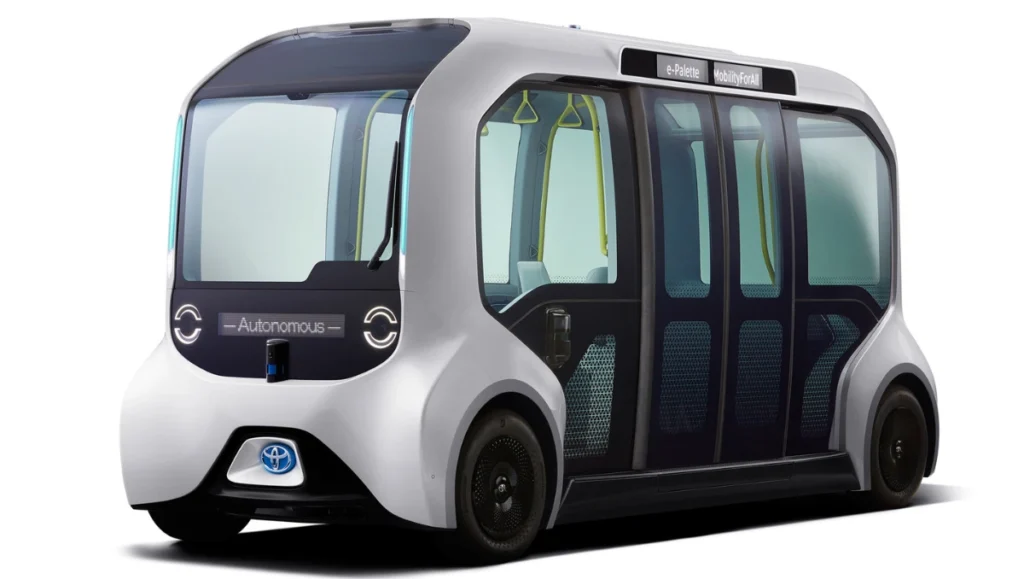
Toyota has introduced the e-Palette, a purpose-designed electric people mover that marks a key step towards hands-free urban mobility. Toyota Launches e-Palette in Japan with Level 4 Autonomy Roadmap. The e-Palette, priced at 29 million yen (approximately 1.74 crore rupees), comes as a roomy, emission-free shuttle and platform for future autonomous mobility. At launch the vehicle provides Level 2 driver support, and Toyota aims to deploy Level 4 hands-free capability during April 2026 to March 2027 by way of demonstrations to dealers, municipalities, and technology partners.
What the e-Palette is intended for
The e-Palette is a purpose-built vehicle or PBV intended mainly to transport people in an emissions-free bundle, but with its modular design it is also feasible as a mobile shop, clinic or service unit. In the normal configuration the shuttle has room for 17 passengers plus the driver, with four seated and standing space for twelve. The intention is adaptability: operators can rearrange the interior according to passenger transport, last-mile logistics or community services.
Space, openness and packaging
The e-Palette has 4,950 mm of length, 2,080 mm of width and 2,650 mm of height. Its box-like shape maximises the interior space for use. Some of the most important cabin dimensions are 2,865 mm in length, 1,780 mm in width and 2,135 mm in height allocated to passengers. Its low floor height of 370 mm, which can be reduced to 270 mm, and wide door openings (1,900 mm high and 1,280 mm wide) facilitate easy boarding and alighting by elderly or mobility-impaired passengers and ease wheelchair access.
Powertrain, range and charging
Below the floor of the e-Palette is a 72.82 kWh battery pack that drives an AC synchronous motor rated at 150 kW (201 hp) and 266 Nm of torque. Toyota cites a WLTC-based range of around 250 km from a full charge, and a top speed restriction of 80 km/h, numbers that are in line with the vehicle’s prospective role as an urban, low-speed mover. Fast charging to 80 percent in a mere 40 minutes from a 90 kW DC charger makes it viable for fleet operators who require swift turnaround throughout the day.
Autonomy roadmap: Level 2 now, Level 4 soon
At introduction, the e-Palette provides Level 2 automated vehicle capabilities like adaptive cruise control and lane-keep assist with still the need for driver attention. Toyota intends to develop the system into Level 4 autonomy in controlled environments. Level 4 would enable hands-off operation without human intervention within specified zones, pending regulatory approvals and extensive real-world testing. Toyota’s strategy integrates vehicle development with partnerships and local trials to provide safety and reliability prior to widespread deployment.
Practical application and commercial value
The e-Palette targets fleets, transit organizations and groups that require flexible, low-emission mobility. Common application scenarios are:
- Shared passenger shuttle services to and from airports, campuses and tourist destinations.
- Mobile shopping stores or food-serving units that may take commodities to the neighbourhoods.
- Mobile health clinics that facilitate remote communities or events.
- Last-mile delivery pods for cities looking to minimize inner-city emissions.
This flexibility makes the e-Palette appealing to municipalities, mobility operators and corporations who desire a purpose-designed electric vehicle for specific services in place of modifying conventional cars.
Design aspects that are important
Toyota has emphasized accessibility and functionality. The interior design favors circulation space and convenient entry, with the squared shape assisting in maximizing cargo space and passenger volume. Large glazed areas enhance outward vision and passenger comfort. Functional elements like low-floor boarding, generous doors and adjustable seating are conscious design decisions to minimize dwell time at stops and optimize passenger flows.
How the e-Palette aligns with Toyota’s mobility vision
The e-Palette represents Toyota’s larger movement away from selling individual cars towards mobility platforms and services. With the combination of electrification, autonomous tech, and modular design, Toyota is poised to provide end-to-end mobility solutions that exceed personal car ownership. The e-Palette also indicates Toyota’s focus on incremental, safety-centric adoption of autonomy, through phased upgrades and real-world tests.
What to expect next
Partner pilots and real-world demonstrations will be essential. Toyota intends to collaborate with technology vendors, dealerships and local governments to optimize the autonomous stack and operations. Regulatory approvals, infrastructure readiness and public acceptance will define the level of rollouts of Level 4. If successful in the trials, the e-Palette can be a valuable building block for future urban transport networks in Japan, and a model for analogous services elsewhere.
Conclusion
The Toyota e-Palette is a sensible and vision-led car: not simply an electric van but a flexible mobility platform designed for a low-emissions, more autonomous future. With spacious interior room, functional accessibility options, a strong electric powertrain and a designed roadmap to hand-free driving, the e-Palette addresses fleet operators and public service providers initially. Its launch price places it as a fleet investment, but the car shows how city transport can evolve towards more flexible, sustainable and automated solutions.
—-