Triumph’s New 350cc Range: The Strategic Reset for India’s Performance Segment
Bajaj Auto MD Rajiv Bajaj broke the news on February 26, 2026, that Triumph’s New 350cc Range is “ready for the market” with an April 2026 launch date. This is a massive strategic shift for the company. This is much more than a small update—it’s a calculated move. After seeing how well the 400cc models did, the partnership is now downsizing to navigate a new tax landscape that threatened to make premium motorcycles way too pricey for most people.
The GST 2.0 Catalyst: Why Triumph’s New 350cc Range is the Magic Number
The driving force behind Triumph’s New 350cc Range wasn’t a desire for less power, but rather a drastic change in the Indian government’s taxation policy known as GST 2.0, which rolled out on September 22, 2025. Under these new rules, the 28% tax bracket was scrapped in favor of a binary system. Motorcycles with engines displaced at 350cc or below are now taxed at a much friendlier 18% GST. However, any bike even one cubic centimeter over that limit—like the current 398cc Triumph engine—is slapped with a 40% luxury tax.
This 22% tax gap essentially added a “luxury penalty” of nearly ₹50,000 to the price of the Speed 400. For a brand that wants to dominate the middleweight segment, this was a massive hurdle. By developing Triumph’s New 350cc Range, the company can bypass the luxury tax entirely. This move allows them to drop the ex-showroom prices significantly, potentially bringing the entry price down to the ₹1.70 lakh to ₹1.90 lakh range, making it a direct threat to the bread-and-butter models of long-standing market leaders.
Engineering the Shift: What’s Under the Tank?
Many enthusiasts were initially worried that “downsizing” would mean losing the soul of the bike. However, technical details emerging from the Chakan plant suggest a very clever bit of engineering. The upcoming engine in Triumph’s New 350cc Range is not a cheap, air-cooled unit designed to save money. Instead, it is a modified version of the high-performance liquid-cooled 400cc mill.
Triumph’s engineers have reportedly reduced the bore of the cylinder while keeping the stroke mostly intact. This “under-square” or “square” configuration often results in a bike that is easier to ride in city traffic because it provides better torque at low RPMs.
Expected Performance Figures
The old 400cc was a rev-happy 40 hp animal, but Triumph’s new 350cc unit is leaning into a very different personality:
- Maximum Power: You can expect the power to settle in that sweet spot around 32–34 hp.
- Torque Delivery: Peak torque might drop a bit to around 30–32 Nm, but you’ll feel it kick in much earlier when you pull away.
- Rideability: The big win here is “tractability”—basically, you can pull away from low speeds in higher gears without the engine coughing or cutting out on you.
The April 2026 Lineup: A Model for Every Rider
When Triumph’s New 350cc Range debuts in April 2026, it is expected to consist of at least three distinct models to cover various parts of the market.
1. The Speed 350
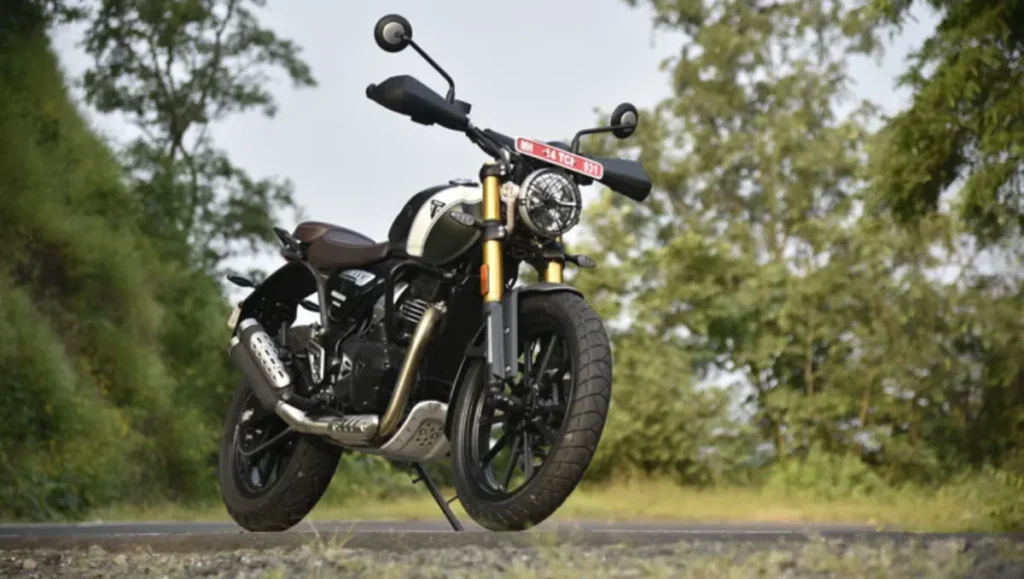
This will be the volume driver. Visually, it will likely retain the classic “modern retro” look of the Speed 400, including the premium USD forks and the signature fuel tank shape. It’s the ultimate value play—Triumph kept the premium cycle parts and used the 350cc engine to dodge heavy taxes, resulting in a high-end feel for the price of a commuter.
2. The Scrambler 350 X
The Scrambler 350 X is all about that rugged lifestyle, offering extra suspension travel and a look that means business. Because of the new tax laws, it might just become the cheapest “true” scrambler available in India. Compared to the older air-cooled bikes in this segment, the technology and performance you get here are in a completely different league.
3. The Speed T4 350
There is also strong talk of a “Speed T4” version within Triumph’s New 350cc Range. This is expected to be the most affordable entry point, perhaps using traditional telescopic forks and simpler paint finishes. Word is that this specific model might start as low as ₹1.70 lakh, which would put every 250cc to 350cc bike in India on notice.
Keeping the Premium Edge: Features and Build
One thing Rajiv Bajaj made clear is that the partnership isn’t interested in making “budget” bikes that feel cheap. Triumph’s New 350cc Range will likely maintain several features that its competitors often omit to save costs. Expect to see:
- Liquid Cooling: This is a total lifesaver for the engine’s lifespan and performance when you’re stuck in those brutal Indian summers.
- DOHC and 4-Valves: This engine runs circles around the older 2-valve designs that still power a lot of the 350cc competition.
- Ride-by-Wire: You’re going to feel a way more instant link between your right hand and the motor, plus the fuel savings are looking pretty solid too.
- Safety Tech: Standardizing dual-channel ABS and slipper clutches is a smart move that will help Triumph pull ahead of the budget pack.
Competition: The Battle for the 350cc Segment
The 350cc bracket is the ultimate battleground for Indian manufacturers. For decades, it’s been a solo act by a brand that successfully sold the dream of retro heritage and that iconic, thumping exhaust note. Triumph’s entry into this specific displacement bracket changes the rules of the game.
In the past, Triumph was seen as a “premium alternative” for those who could afford to pay more. Now, with the tax-corrected pricing of Triumph’s New 350cc Range, they are going toe-to-toe on price while offering nearly 60% more power and significantly better technology. It’s no longer a choice between “cool and old-school” vs. “fast and expensive.” It’s now a choice between two bikes at the same price, where one is objectively more advanced.
Production and Resale Outlook
The bikes will be manufactured at the Chakan 2 plant, which has already been optimized for high-volume exports. Interestingly, the 400cc versions will continue to be produced for international markets where the 350cc tax rule doesn’t exist. This means India is getting a special, “tax-optimized” version of a global platform.
For current owners of the Speed 400, there is no need to worry about resale value. Because the 400cc is now hit with a 40% GST, the original “pre-hike” 400cc bikes might actually become highly sought-after in the used market by people who still want that extra 5 hp and are willing to pay a premium for it.
Final Summary: A Game-Changer in April 2026
You can’t overstate how big Triumph’s New 350cc Range is for the Indian market come April 2026. While other companies are complaining about tax hikes, Triumph is busy innovating. By landing in that 18% GST bracket with a high-performance, liquid-cooled motor, they’re finally making “luxury” bikes affordable for the average guy.
Whether you are a daily commuter looking for more excitement or a weekend tourer looking for better highway manners, the new 350cc range offers a solution that was previously blocked by a high tax wall. April 2026 can’t come soon enough for the Indian rider.
Showrooms, the resale value of the 400cc units might actually stabilize. Since the 400cc will now attract a much higher tax, it becomes a “rare” high-performance variant that cannot be bought cheaply anymore. Owners of the original 400cc “tax-free” units (purchased before the GST hike) might find their bikes are in high demand on the used market.
Final Thoughts: A New Era for Triumph in India
The arrival of Triumph’s New 350cc Range in April 2026 marks the end of Triumph being seen as a “niche” luxury brand in India. It is a full-scale assault on the heart of the Indian motorcycle market. By navigating the complexities of local taxation and leveraging the manufacturing prowess of Bajaj, Triumph is providing a high-tech, high-performance alternative to the traditional long-stroke singles that have dominated the roads for half a century.
If you’re a student hunting for that first big bike or just an experienced rider looking for a sharp urban runabout, the April 2026 launch is a date you can’t afford to miss. The price drop is real, the tech is proven, and the British heritage is intact.
FAQs – Triumph’s New 350cc Range: Price Drop by ₹50,000 this April?
1: What is the real reason for the 350cc engine swap?
It is a pure tax dodge. The government basically started taxing 400cc bikes like luxury yachts, so Triumph chopped the engine size to stay in the 18% GST bracket and keep prices sane.
2: When are these bikes actually hitting the road?
The boss, Rajiv Bajaj, finally spilled the beans on February 26, 2026. He confirmed a solid launch date for April 2026, so the wait is almost over.
3: Did they ditch the liquid cooling to save a few bucks?
Nope. Even with the smaller engine, Triumph kept the radiator. It is a massive win because air-cooled bikes usually struggle and lose power during those brutal 45°C Indian summers.
4: How cheap is the base model actually going to be?
If the rumors from the factory are right, the Speed T4 might land at ₹1.70 lakh. That puts it right in the crosshairs of every 250cc bike on sale.
5: Is the power drop going to be a dealbreaker?
Look, you’re looking at 32–34 hp. It’s not a 40 hp screamer anymore, but it is way more “tractable,” meaning it pulls harder from low speeds without needing a downshift.
6: Are they skimping on safety to hit that low price?
Triumph isn’t playing that game. You still get dual-channel ABS and a slipper clutch across the whole range, which is more than what most “budget” rivals offer.
7: Is the Scrambler 350 X just a Speed 350 with different paint?
Not quite. It has a taller stance, extra suspension travel, and a beefier look. It is the one you want if your daily commute involves a lot of broken roads.
8: What happens to people who already bought the Speed 400?
You are actually in luck. Since new 400s are now hit with a 40% tax “penalty,” your original, cheaper bike is likely going to be worth a lot more on the used market.
9: Does the engine sound different from the old ones?
It won’t have that slow, heavy “thump” of a classic 2-valve engine. It sounds much more modern, mechanical, and crisp because of the DOHC 4-valve setup.
10: Is India the only country getting these 350cc models?
Mostly, yes. This is a “tax-special” for our market. The rest of the world will keep getting the 400cc versions while we get the tax-friendly 350s made in Chakan.
—